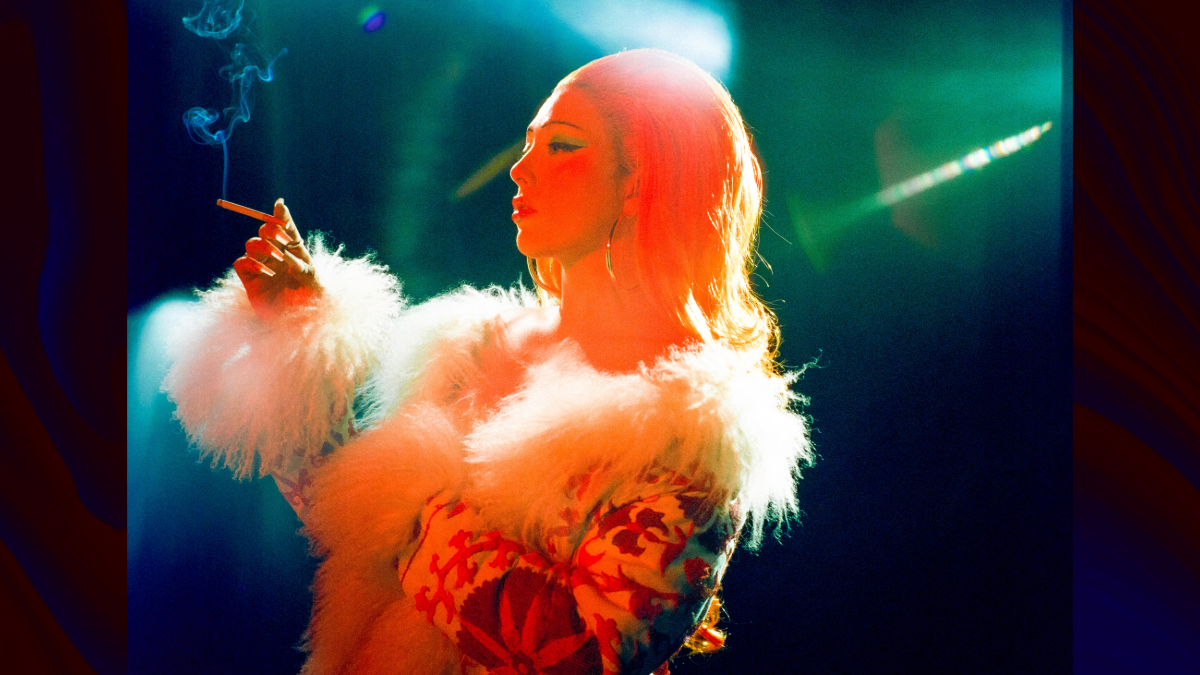
From Shania Twain to Quentin Tarantino, Kitty Coen’s lifelong influences and personal reflections seep into her “sexy, witchy rock music.” The journey to finding her visual and music identity has now culminated with her new album Hellcat.
“I literally until recently have always fought making country music,” admits Coen, who didn’t initially want to listen to the same music as everyone else from her hometown. She grew up listening to country and pop country, and even made her teachers call her Shania Twain in school until second grade. The idea of country being part of her sound was another story.
She moved to Austin, Texas for college, and felt that although she found her music community, it was in a bubble. During COVID, she decided to move to Nashville, and that experience would prove to be incredibly formidable. Coen admits that moving to Nashville was “so painful” in the beginning. She didn’t know anyone, and the caliber of talent felt intimidating.
“Nashville is not the place that you come to to become famous. It’s the place that you come to to become a better artist and a better musician,” she explains. The exposure to a wide variety of talented artists pushed her to perform on stage, record a lot of material during recording sessions, and play guitar while singing- despite having stage fright. “Talent is not what means you’re going to make it or not,” Coen says. “It’s hard work, and it’s persevering through all of the jumps and all of the hurdles that come along with trying to pursue music as a career.”

One of the hurdles in Nashville was navigating an industry that can often be exploitive. She noticed early on she was taken advantage of financially and creatively. While signed to a label, Coen was advised to change aspects of her songs because the label didn’t understand them. She also didn’t feel that she was fully in control of her image, explaining that she felt over-sexualized and even feels embarrassed by some of her early artwork because it didn’t truly feel like Kitty Coen. After these confining moments, the making of Hellcat set off a period of newfound creativity and liberation. “Not trying to be constricted to how a song should be written was so freeing,” she says.
Coen’s artistry is now astoundingly hers. She is the creative director for all of her artwork and music videos, and she asserts that she has always been an artist, even if it took on a different form in the beginning. Her theater background was a huge influence, and the experience of being on set and getting into character eventually helped her create the persona of Kitty Coen. “I wanted to have some type of separation between me and the world, so I didn’t really want to use my birth given name, so it led me to create the character I am now,” she explains.
A character is nothing without a story, and Coen is full of them. She wrote film scripts and has also worked on several Netflix shows, which has helped the story-building process. “Things like films have really helped me create my artistry and learn how to become a better artist…I think that storytelling is probably my favorite part of music,” she states.
Quentin Tarantino’s movies like Pulp Fiction and Kill Bill give off a classic movie feel with a Western spin are particularly poignant and have clearly made their way both into not only her storytelling, but the imagery as well. “Visuals are pretty much what keeps me sane,” she admits.
The visuals are always on her mind, and she even thinks about them as she’s in the songwriting process. Hellcat’s cinematic, warm-hued artwork and music videos are aesthetically consistent, and she carried that mindset into the songwriting process for the album. Even though the album has been in the works for four years, there’s a cohesiveness to its sound. The album’s track listing is generally presented in chronological order of when the songs were created. There was no overarching theme for Hellcat besides what she felt showed who she was, but Coen realized a theme happened as she chose which songs would be on the album.
“When it came time to listen to everything together, I was kind of surprised all of the songs did live in the same world because I feel like sometimes as an artist on a budget, it’s hard to cultivate and make an album that’s sonically cohesive because you don’t have the money to just go in the studio and like, rock out a record,” Coen says. The album’s brooding, country-tinged musings of heartbreak and loss started in a “rage-filled” space in the beginning of the songwriting process, and eventually evolved into something softer, more retrospective, and “magical” as the album progressed. Hellcat is the documentation of Coen’s creative and personal journey the last four years. For an artist that describes herself as shy and anxious, it’s a bold move to lay her emotions bare.
“There are some songwriters that will say you should never write from a place of bitterness, and I don’t really know if I agree with that,” Coen admits. Many of the songs such as “Bad Bad Liar” and “I’m Afraid All Boys Are the Same” that were created in the beginning of writing Hellcat became cathartic avenues to letting out so many of the emotions she built up about previous relationships. “Those songs in me were emotions that I had inside of me for such a long time, that to get them out, to finally hear them fleshed out was almost therapy itself,” Coen explains.

As she found friends she could confide in and started to be in healthier relationships, her confidence to create solely for herself grew and she started to let her guard down. “I was able to be personal without being afraid of what people would say or what people would think,” she says. “I really learned to be proud of who I was and proud of what I can accomplish… actually who I am and not who I want people to think I am.”
The album’s title is a declaration of Kitty Coen’s self-assuredness and confidence that she’s gained. She was fascinated by the history of witches during the making of Hellcat, and used the negative connotation of witches to express how she was feeling as a songwriter. “I feel like in the beginning of this record, it’s Kitty finding her villain arch, and basically saying ‘I don’t care if my sixth sense means that I end of flying to the center of the sun, I’m going to do what I want and how I want to do it.’”
Coen has found that her work has gained more traction once she started making what she truly wanted. “When you stop caring what they think, all of the sudden everybody gives a shit,” she says. “The more authentic I was, the more responses I get and the more support I got.” Artists like Chappell Roan, Ethel Cain, and Wolf Alice have been big influences for being “so unapologetically them.”
Now it’s Kitty Coen’s turn to unapologetically be herself. As Coen herself says, “it’s been a wild ride, and it’s only the beginning.”
Kitty Coen’s album Hellcat is now available.



Leave a Reply