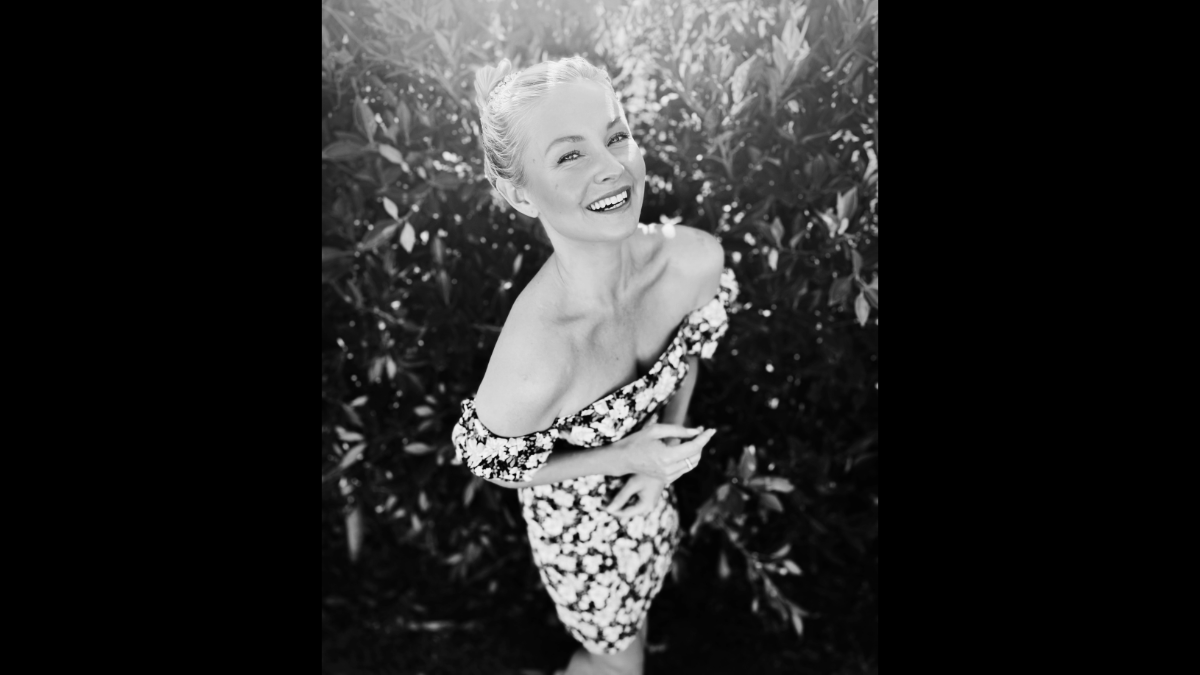
From growing up in a small Swedish town and singing in a choir to now living in oceanside Malibu and releasing music for the first time, Åsa Orbison’s journey has been full of surprises.
Her new album Blue Bayou is a celebration of popular traditional standards reimagined as jazz tunes. Complimented by her breathy, calming vocals, it feels enigmatic, yet also intimate. As the album title suggests, Roy Orbison’s presence is felt on the album, but for her, it’s also personal.
She was working in marketing while still living in Sweden when she met and fell in love with Roy Orbison Jr., and then moved to the US and started a family. As Roy Orbison’s daughter-in-law, she has been able to see Roy Orbison’s impact firsthand, and she even contributed backing vocals for the Unchained Melodies compilation album that also featured the Royal Philharmonic Orchestra.
Now she’s developing her own artistry and reconnecting with her childhood love of singing, all while keeping the familial bonds close by.
Culture Flux: How did you discover jazz music? Was that something that you’ve always been drawn to and you’ve always listened to?
Åsa Orbison: Yes, you know, there’s this Swedish musician called Monica Zetterlund that I really liked when I was a child. I think I mentioned her in my bio. She sang a lot of songs in Swedish that I later discovered was actually her translation of jazz classics, so I listened to that- Waltz for Debby. She’s got one called “Monicas Vals,” which is on my album if you heard the two Swedish songs, and “En Bedårande Sommarvals” is from “Bluesette.”
I was pregnant with my first son, Roy Orbison III, and Roy [Orbison Jr.] got into jazz, cause it was kind of the last genre that he hadn’t really played, so he was in my apartment and he was playing guitar, and I came home and he was playing these songs that I thought of as Monica Zetterlund. Obviously they were classics. They were like, Duke Ellington and big, old jazz legends. I started singing over them in Swedish and Roy was like, “how do you know this?” So that’s how I kind of got into jazz. And now we’re deep into Julie London and Doris Day, and all of these old-time torch singers.
And I know that you mentioned her earlier and you’ve said also in the past that you’re inspired by Julie London and I’ve always loved her voice. It’s so beautiful. What was it about her music that really captivated her when you first heard it?
It’s the music behind her, but it’s like, when you hear her, it sounds like you can’t really place her, and these long, soft notes that sometimes are uncomfortable. You really wonder what’s on her mind and you can read her, but there’s a lot of mystique around her.
And then you learn that she was this suburban housewife. She loved to care for her children and her home, and then she smoked three packs of cigarettes a day. I’m trying to get the time to read her book right now. I’m actually going to watch a documentary about her after this, because I’m really interested. She’s just really mysterious.
So you’re a mother and you have four kids, so I’m sure it’s a challenge to pursue music while also having four children, but do you feel like you’ve been able to figure out a comfortable balance between motherhood and your creative pursuits as well?
Yes, because children are the best way to learn to stay present, and if you apply that to the time I have… if I’m really present when they nap, and I decide, “no, I’m going to sit down and do this,” then I will get to it, versus if I didn’t have kids I would maybe spend the whole morning wandering around. That’s good for productivity too, but I really have to be productive.
And how has being a mother influenced you artistically?
The most amazing thing is that I think a lot of artists kind of sit on their things in the closet and they’re either afraid to let it go and release it because they wait for something to be perfect.
Especially women do this and it’s sad, because we’re so tough on ourselves. You as a writer, too.. you know, you sit there and you pick on every little word and you think, “oh, maybe someone won’t understand this” or “maybe this comes out the wrong way…” something like that and then you end up not releasing anything. And you’re just sitting on that.
When I had kids, I realized I only care what they think about me. I don’t really care about what anybody else thinks of me but my four kids and my husband, mostly the kids honestly (laughs). It just made me able to let go of that and pursue what I wanted because I’m not scared of anything and nothing has to be perfect. As long as I’m going to be with them, everything else is good. I think it gave me courage.
You sang backing vocals on the Unchained Melodies album. What was that experience like? Was that nerve-racking? I know there was an orchestra and everything, so it was quite a large project.
Yeah, the orchestra was recorded in England though, in London, and then we were in Nashville doing the background vocals. So the Orbison family met up, and it was really a family day. It was really fun. I had little Beau and Roy III there too. I think Beau was six months old, so I was really busy with him, on the day, but we rehearsed a lot! And I loved doing background vocals. I love experimenting with background vocals. Yeah, it was just a day with the family and my sister-in-laws. It was really a great experience.
How did that recording affect how you decided to approach the recording for Blue Bayou? Did that influence it in any way, or help you prepare?
Yeah, because I had no plans of recording my own album when we were doing that, but Roy and I were rehearsing at home a lot, like I said, and “Blue Bayou” was the one song that we started with, where Roy started to substitute some chords with more jazzy chords, and then I started to sing over it. I changed some of the notes, like you can hear on my version, and that was absolutely the spark of doing something like that.
And then I just found my voice again. I hadn’t been singing for maybe 15, 20 years. So, I sang as a child, but it wasn’t until I met Roy and we did that recording that I started to sing again.
So did you do vocal lessons as a child? Were you part of a choir?
I did, I was part of a choir, and that was really fun, and then I went to music school. My instrument was piano and guitar. We had one hour of music everyday for that school, and it was probably for about 3-4 years. Then I just went into marketing, and I didn’t really pick up music again until I met Roy.

Is there part of it that feels kind of nostalgic when you first went back to music, since you hadn’t really delved into it since you were a child?
Yeah, absolutely. I get that feeling in my stomach. It’s a good feeling in my stomach. Singing is very meditative and it’s great for you. You take deep breaths, and it’s like meditating. It does a lot to you on a physical level too.
Do you get nervous? Because the style of jazz you’re singing… really the vocals are all on display. Of course there’s an instrumental, but your voice is really at the center of it, so does that make you nervous?
Sometimes yes. Once you approve it and you put it out, that’s not too scary, but it is a bit scary live. Live is more challenging, but I trust my voice. It sucks when you have a cold, and I have four kids, so you can imagine (laughs). We’re just jumping from one to the next. It’s challenging to keep the voice in good shape, but I’m doing some vocal mists and I try to stay healthy.
So going back to Blue Bayou, how did you choose which songs to reimagine for the album? Because there are so many jazz standards and classics that you could choose from? Was that a difficult choice to figure out which songs to showcase on the album?
Yeah, but it’s a lot of Roy, my husband. Roy loves to make lists. He’s great at like, “oh, the best of this genre is these…” He loves to make those kinds of things. It’s like a game for him. I love whatever he picks, and we’ve kind of picked together on this one. “Unchained Melody” I think I picked. “Green Eyes” I had never heard before. He’s really good at finding songs that were big, but didn’t make it all of the way to this year, you know, this far. I find so much inspiration in that. He’s really good at digging up good, old stuff.
Can you talk about the choice to extend the arrangements on “Blue Bayou” the song? Because you have this really beautiful saxophone and harmonica solo that extends beyond how long the original song is. Can you about how that came up with using that arrangement?
That was Roy’s idea, but we wanted to include Charlie McCoy, who is a dear friend, and he played with Roy Orbison. And we also wanted to include Jim Horn, who also played with Roy, and Traveling Wilburys, George Harrison, Tina Turner, Frank Sinatra… these are some heavyweight musicians. We wanted to really bring the focus to them, because they’re really the stars of the track.
So, Roy worked out- I don’t know how long it is, it’s probably like, 1 1/2 minutes, it’s my favorite part of the song- and I think from the beginning we started with Charlie, with harmonica, and then Jim came in, and I didn’t think that a harmonica and a saxophone would work together, but they really do. I had never heard a harmonica and saxophone solo. Roy imagined two birds flying out on a horizon towards the end, and I really think that they captured that.
How has Roy Orbison’s legacy inspired you?
When I met Roy, we were in a park in Sweden and it was all random. I didn’t know who he was. He sat down next to me and we started to talk, and he said, “my name’s Roy Orbison Jr.” and I said “that name rings a bell,” but I couldn’t place it. Then, we googled his father together, and I could just see I knew all of the songs.
I listened to a lot of 50s music when I was growing up in Sweden, so I think the songs I had heard then were “Blue Bayou” and “I’m Hurtin’.” I think it was those two, but then “You’ve Got It” and “Pretty Woman” obviously.
He inspires everything that we are today. He’s in my children, he’s in my husband, so genetics are everywhere, and the music. The life we have today is thanks to him, so he is everywhere, rightfully, and we thank him everyday.
Which musicians have you met that you feel like had the biggest impact on you and inspired you the most? I’m sure you’ve met so many people now.
Just the other day we went to Ringo’s for his grandchild’s birthday, but they’re all just humans. Ringo inspires me with his diet. He eats a lot of broccoli and blueberries (laughs). He’s very healthy. These guys are amazing. I think Joe Walsh is like, a yogi. His presence is amazing. He’s just calm and very thoughtful, generous, and at peace somehow. He’s my children’s godfather.
Musically? I mean, little Roy III is inspiring- my son. He’s eight, and he picks up with guitar and he goes into another world. He’s just gone, it’s amazing. He had that relationship with his guitar. I’m just as impressed by him as anybody else really.
So you might start a family band then?
Yeah, I think we already have (laughs). He’ll watch something on TV and they’ll play something and he just plays it. And the other kids are just right behind, I can see.
As far as Blue Bayou, I think it has a very calming effect when you listen to it. What artists do you listen to when you just want to relax or unwind after a busy day?
Now I’m just so deep into Julie London, but there’s this Swedish musician called Lisa Ekdahl. I do listen to her, she does a lot of jazz too, but pop jazz. I grew up with her music. And Doris Day, I do like Miles Davis… I listen a lot to The Eagles. We’re going to see them in a week at the Sphere in Las Vegas. I love The Eagles, Amy Winehouse, I love Amy Winehouse. A little more feisty than me (laughs).
So do you think that going forward, you want to keep going down the route of jazz standards, or are there other songs within other genres that you would like to transform into a different verision?
Do you know about the term “torch singer,” “torch songs?”
Yes, old love songs, yes.
Yes, I think that’s my genre. I want to sing about love songs, intimate, where I can keep my breathy singing style. I’m very comfortable there. I feel like I can be myself there. I think that’s where I’m going to be. And then you want some upbeat songs too maybe to spice it up (laughs), but yeah, that’s where I’ll be.
What are you most excited about for people to hear from Blue Bayou?
This next last song, “Baby I’m Yours,” coming out on the 15th. I’m really excited about that one, because that one really puts my voice first. It’s a little bit different than the rest, as far as the opening is only my voice. It’s very intimate and vulnerable.
And as far as the future, what are your goals for new music? Are you going to be writing original material? Would you like to do more covers? What are you planning for?
We’re doing both. We’re writing some original material right now. I’m thinking it will be out in January maybe. My other goal is just to get out and tour.
Nice. So how are you preparing for that versus recording an album?
It’s a lot of logistics with the kids (laughs)! But yeah, so when I prepare for that, I have to practice performance obviously. That’s a little bit different, but I’m not going to twerk. That’s not my style. I’m not even going to try because that’s not me, so it’s a bit different than what women usually do now, because it’s a lot of show on women. You don’t see it as much on men. I’m going to sing, and I’m hoping to have some really good musicians on stage to saxophone and cello hopefully up there, with some extended solos. I’d love to give them space too. I think that’s important. Yeah, but it’ll be a lot of preparing just to plan anything with the kids.
As my closing question, I just want to ask, did you learn anything about yourself while recording this album?
Yeah, I think I learned to be more ballsy and just do. Just do, and you go on to the next. It’s good to reflect over things and think about “what can I do better,” but it’s also good to let go and move forward.


Leave a Reply