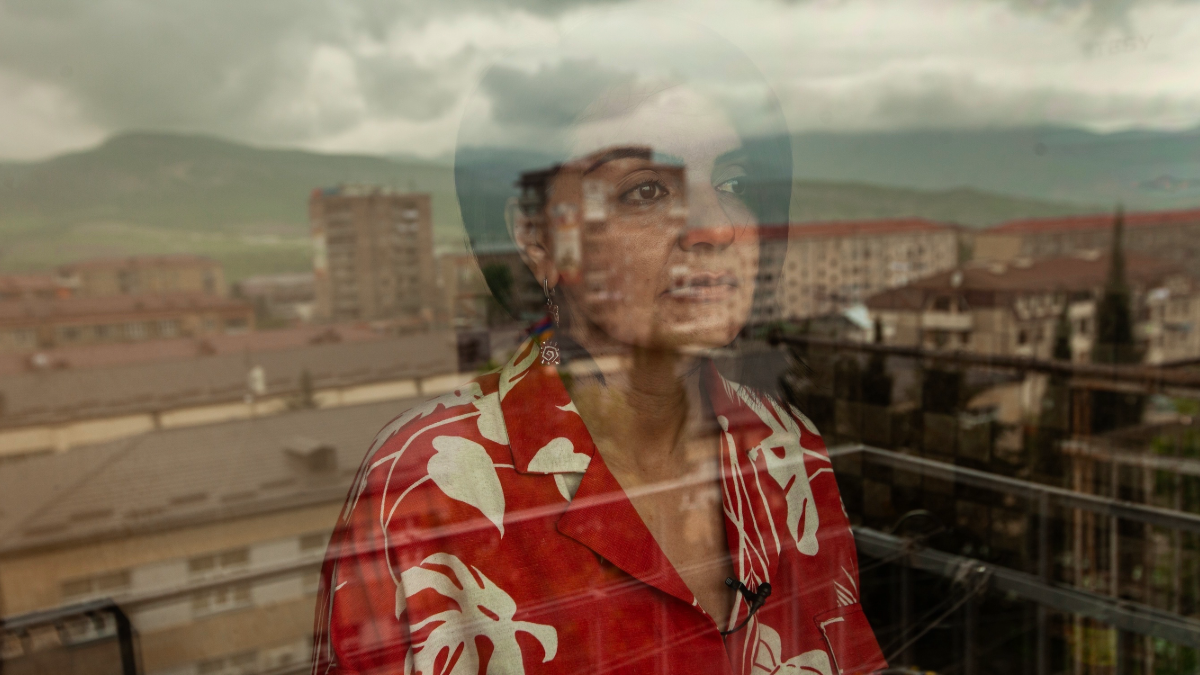
Emily Mkrtichian never intended to make a documentary about war. There Was, There Was Not began as a deep dive into the every day lives of four resilient Armenian women in the Republic of Artsakh, but then war broke out. Now the film is a lasting tribute- documenting the regular days and the last days of a region whose courageous civilians refuse to let their history and culture be erased.
While living in Armenia, Armenian-American filmmaker Emily Mkrtichian made a short film in 2016 about the demining efforts in Artsakh- a region still reeling from the effects of war and territorial disputes with Azerbaijan during the 1990s. The organization HALO Trust– which has cleared landmines all over the world in war-torn countries- had women assisting with mine removal for the first time. As Mkrtichian was documenting this group of strong women, she met Sveta. An independent, hard-working woman who joked about not having a husband, she was nonetheless providing for her family while keeping the country safe. Sveta was the first of four women Emily met that would eventually be featured in the documentary.
Mkrtichian knew she wanted a collection of women in different periods of their lives. Each of the four women’s stories are distinct, yet inextricably impacted by Artsakh’s turbulent history. “I was interested in the different ways that all of these women were kind of working to protect their families and their community,” she explains.
In the same ways that recent Oscar winner I’m Still Here lets viewers peak into the lives of citizens living their lives with humor and boldness before turmoil, There Was, There Was Not settles into the reality of the every day yet impactful lives for Sveta, Sosé, Siranush, and Guyane.
The women laugh, make jokes, interact with the community- it’s this crucial depiction of their day-to-day activities and feelings that truly make what is to come so much more heartbreaking. We’re connecting to these women and revel in the joy and humor they embody despite Artsakh’s traumatic history. We’re rooting for Sosé’s Olympic dreams, for Siranush’s political success, and for the community’s continued healing.
“That was one of the most important things structurally for the film,” Mkrtichian says, referring to building an emotional arc and balancing the depiction of the subjects before, during, and after war. “For me it was really important that a big part of the film was actually experiencing the beauty of this place and these women on their own without knowing that that way of life was going to be in danger.” She was working against the established genre of war, for which establishing imminent danger and violence is often crucial to keep audiences interested.

When documenting the women in their homes, she was usually holding the camera. Instead of bulky gear creating a distance from her and the subject, Mkrtichian often shot in a handheld style fitting for the liveliness of Sveta, Sosé, Siranush, Guyane, and their families, but it also allowed the filmmaker to gain the women’s trust. Intermittently, Artsakh’s breathtaking, mountainous beauty is framed in moments of serene stillness- images frozen in time like postcards from the past.
The initial scenes of joy are how Mkrtichian experienced Artsakh when she started filming for a little over three years. “The switch or break that happens in the middle kind of represents a little bit of the mindset of all of us- that we didn’t see it coming,” she remarks. “We would have loved to tell any other story.” Each of the women featured in There Was, There Was Not respond to the conflict in their own way, but all are equally heart-wrenching.
As chaos breaks out, the camerawork becomes jolting, and a sense of fear permeates from the shaking scenes. “There’s an intention to really allow the person watching to understand there’s someone behind the camera. There’s a real person who’s also experiencing all of these things and kind of trying to make sense of them in real time,” Mkrtichian says.
There were moments when she questioned if she should still be filming after the attacks started in 2020. One of the most surreal moments was when she received her first major grant for the film during the second day of the war. As she opened an email from the Sundance Institute, she was taking cover in a bomb shelter. Mkrtichian didn’t have any safety training for filming in a war zone- even Vice News’ team encouraged her to leave before they left. As an Armenian that was born and raised in the US, she had always wrestled with the idea that she had the choice to leave whenever she wants, and didn’t feel it was right to take off when the other women couldn’t.
Azerbaijan took control of the region (internationally recognized as Nagorno-Karabakh) in six weeks, and thousands of people living in Artsakh fled to Armenia. Editing such a personal project was a confounding process for Mkrtichian. For two full years she labored over finding a narrative amidst the disarray of the last several years.
“There were moments after the war when I really questioned if I wanted to make a film about this- if it was worth continuing,” she admits. Mkrtichian had trouble finding a cohesive narrative for such a fragmented perspective, explaining that it “took a really long time in the aftermath of the conflict to understand what, if anything, could be said about something so horrible.” It took a full year after the war to understand that there wasn’t some kind of simple, tidy meaning she could offer about what had happened.
Artsakh was impacted in unimaginable ways, but its violence wasn’t the only story to tell. Mkrtichian needed to find a balance between the bitter and the sweet, stating that she “didn’t want to make a film that was just focused on the tragedy of this place and that tried to elicit not empathy, but almost sympathy.” Telling the full story meant capturing the complexity of Artsakh’s women both before and after the invasion. “I want them to understand the gravity of what happened, but these are real people who had full lives. I think it’s important to know that that existed before it was ripped away.”
Near the end of the film, there’s a profound statement made in the aftermath of displacement: “They vowed to never forget and always tell the story, because their stories were the only power they had left.” The film is a preservation of a culture that no longer belongs to the region- a historical artifact itself.

Mkrtichian’s family was displaced by the Armenian genocide in 1915. When she went back to Armenia, she was the first person in her family to go back to current day Armenia, and eventually brought her family there.
“In some ways, my engagement with this place and this culture, outside of the stories and the things that have been communicated to me through my family, have always happened through filmmaking and through creative work,” Mkrtichian says. She worked in a film studio in the capital city Yerevan, where she learned everything she knows about filmmaking. “Through this medium of film and through my own lineage, I’ve just made all of these really incredible connections- some difficult and some really healing.”
With the displacement of her family in mind, it was important to think about what to pass on to future generations. Mkrtichian was pregnant for the first time while editing, then her child was born right after the film was released. She asked herself what she would want her kid to know about Artsakh. It didn’t need to only be a story about a place steeped in tragedy. “I want my kid to know about the capacity of joy of Armenians in the face of tragedy and that we’ve created places that were fully alive and beautiful,” she states.
The documentary’s first public screening in Armenia at the Golden Apricot International Film Festival was one of the most emotional experiences she’s ever had. The screening was about 1 1/2 years after Artsakh was lost, and audience members felt a catharsis as they collectively were able to share their experiences with others who had been through something similar.

Mkrtichian hopes to do more community screenings soon, and provide a space for Armenians and others from the SWANA region to have a space for conversation, building solidarity, and healing.
Reflecting on what she hopes audiences take away from There Was, There Was Not, Mkrtichian emphasizes the importance of revealing how women support the community in times of conflict. The majority of soldiers fighting the wars may be men, but women have to hold the family together. They are the caretakers, the nurturers, but also bearing the emotional weight of collective struggle.
“It’s not often enough that we see these conflicts from the point of view of women,” she says. “I think it’s very clear that in these conflicts and in the wake of these conflicts, women end up holding so much of what happens and repairing so much of what happens in the aftermath.”


Leave a Reply