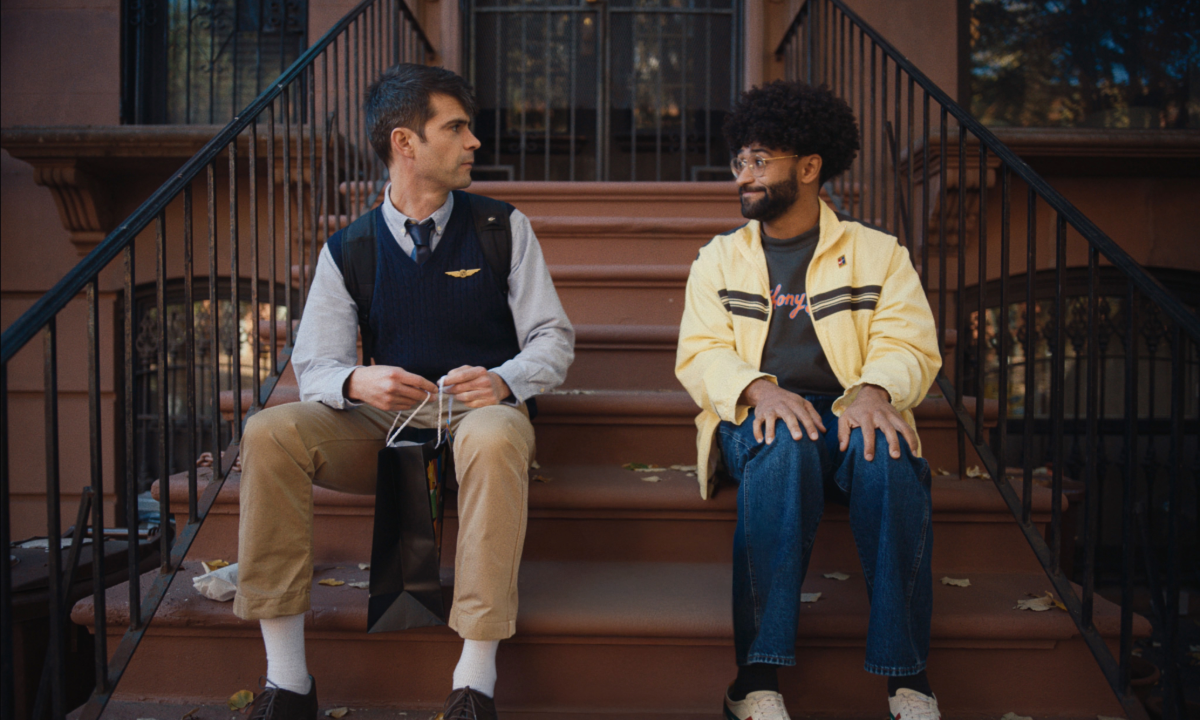
During a reflective scene in a photo lab, Raheem Roher’s character Junior points out to aspiring filmmaker Simon (Tristan Turner) that you’ve “gotta grasp life in the moment that we’re living in right now. I mean, you’ve gotta appreciate what you’ve got. It’s not about what you want.”
Simon’s inability to grasp this concept leads to some uncomfortable yet comical interactions with his best friend Bruce (Anthony Oberbeck), who works for an airline and begins a budding relationship with Beatrice (Naomi Asa). Bruce’s new relationship starts to threaten Simon’s free flight benefits, and a sturdy friendship starts to run amok.
The Travel Companion settles into the discomfort on many occasions throughout the unconventional buddy comedy- often making us shake our heads and facepalm as Simon just digs a deeper hole instead of appreciating the friendship that he has.
It’s not the typical structure of an argue-and-make up story, and that’s exactly what directors Travis Wood and Alex Mallis wanted: to set the film in a realistic scenario that is more relevant to how friendships can evolve (or devolve).
From the conversations between filmmakers to the free flight benefits, many aspects of The Travel Companion‘s narrative mirror Wood and Mallis’ real-life experiences. Shortly after the film’s premiere at Tribeca Film Festival, the director duo spoke to Culture Flux about the comedy’s realistic components and the realities of being an independent filmmaker.
Culture Flux: Because this isn’t a typical buddy comedy movie about friendship that you normally see, I wanted to talk about the process of deciding how much you wanted to pull from your real life and how much you wanted to pull from fictional storytelling.
Travis Wood: Yeah, I think everything is somewhat inspired by real life- started with a seed of something that happened to one of us three that wrote it and then from there we kind of fictionalized it. So I had the free flight benefits and lost them when my buddy got a girlfriend, but it did not play out anything like the film. And Alex had a job filming taxis back in the day.
Alex Mallis: Yeah, I think when we were writing it, the stuff that came easiest was the stuff that we had a point of reference for. The things that we had experienced.
Obviously Simon is a documentarian and even an experimental documentarian. We both dabbled in that art form. We’re definitely both independent filmmakers living in Brooklyn. We’ve experienced a lot of these things and it just felt appropriate to find ways to incorporate them into the story.
Did it feel almost kind of meta when you were on set, and almost like you were kind of reliving some of these experiences or acting them out in some way?
Travis Wood: Yeah, honestly! I feel like, well, even just the whole festival for me felt very meta, because it’s like a lot of the conversations in the film are like conversations that I feel end up happening every time an independent/two independent filmmakers sit down for a beer.
Alex Mallis: It’s true. I mean, our lives are like… if we’re not talking about, you know, career and success and money and getting paid and getting a job, we’re listening to somebody talk about that, so it’s very much a big part of our lives.
I will say though, one thing I was thinking about is that in the film, Simon, who we put a lot of ourselves into, is this sort of directionless filmmaker. But the process of making the narrative, The Travel Companion itself, was actually a very motivated, strategic, thoughtful, organized process that actually felt very clear-headed about and very focused and in control on.
The one kind of irony of it is that in order to make a film about this messy filmmaker, we had to get our shit together.
I like how you tie in… like you were talking about the film festival, that kind of awkwardness of the film festivals, and I’ve been to a few Q&As where it is kind of awkward sometimes as well, and you tie that in with the beginning and the ending of the film.
So did you write- since you were talking about how you know sincere and how well thought out you were thinking about the narrative- did you write into the script the idea of Simon’s experience as a filmmaker becoming full circle from beginning to the end of the film?
Travis Wood: Yeah, the opening Q&A was one of the first ideas of the script. And then, I think at some point it became clear, like, “oh, yeah, we should be ending at one as well.”
Alex Mallis: We were attracted to this motif of repetition, or the diptych, or just things happening either visually or from an action perspective twice. That was like Travis said, the opening and closing was one of the first things that we conceptualized.
And Travis, since you actually had that experience of having the perk of those free flights from a friend, did this film give you a different perspective on that friendship and that experience?
Travis Wood: You know, the real life version was just so much more mellow and cool, where I think we looked at each other on a trip, and he was like, “I don’t need to say it, do I?” And I was like, “nope, loud and clear.”
I think in some ways it was fun to explore some of the things in the ways he wants to keep it. Those will kind of go through my head, but I know my friend, and I know the format well enough that I feel like I could kind of speak for both characters in my head without even asking him. But it was nice to put those full conversations into this.
Alex Wallis: And he’s in the film, too! He got a camera, the actual real friend that works for the airline and gave Travis travel benefits. He plays one of the gate agents that you meet briefly in the middle of the film.
So how much did the dynamic between the both of you inspire the film?
Alex Wallis: I think our friendship is quite a bit healthier than the friendship in the film [laughs]. It’s not like one of us is one character, and one of us is the other. I think, in many ways we are both characters. We put some of ourselves into Simon, and some of the anxieties and existential dramas that he is facing, and we also put ourselves in the shoes of Bruce, and the sort of cool headedness, and down to Earth-ness.
It was less reflective of a drama that we have between each other, and more just like an embodiment of different parts of ourselves.
And then the dialogue was very realistic, and it felt almost observational. Did the actors improvise any of that dialogue, or was it just totally by the script?
Travis Wood: I’d say mostly by the script, but maybe 10%, 15% is…
Alex Wallis: Yeah, there’s a handful of scenes where we had maybe just a slug line: they hang out. We would sort of like half improvise, half feed them ideas like, “you guys should talk about this” or “talk about that.” But we also had a pretty robust script- full of dialogue that they performed really well.
Travis Wood: Yeah, that was a big thing in the writing was just like, “is it real? Does it feel real?” I think at some point it was less concern about pushing the story forward even and it’s just moment to moment. Like, “is this believable?” I think we really didn’t want it to feel writerly at all.

Was that the biggest challenge in the writing process?
Travis Wood: Yeah! I think in some ways. There comes a spot where you feel the inclination of like, “oh, I know what a screenwriting book would say to do here. I know what a reader might want to see at this point.”
Alex Mallis: Like classic three-act structure- insist that at the end of act one like this thing must happen, and there was always a pressure to just insert it, force it in, kind of jam it in, and we resisted it as much as we could. That kind of stuff.
So it was kind of fighting the personal versus the technical?
Alex Mallis: Yeah. One of the first filmmakers that we talked about when we were talking about this film is this Korean filmmaker Hong Sang-soo. He is an extremely prolific, kind of unbridled filmmaker who makes relatively low budget, extremely low budget films that can be very atypical as it comes to narrative. In that often the narrative is extremely loose. He’s just down to have people hang out and pass the time and move through space in a way that is much more closely resembles the way real life works.
If you think of any given period of time- last week, the last month, the last year of your life- it’s not a three-act structure. It’s like a messy unfolding. It’s life! We really wanted to try and make space for that in our film as much as possible and not succumb to the pressure to make this like neat and tidy, Hollywood-ready story.
It had a bit of a Cassavetes kind of vibe to the film- kind of related it to that.
I also want to ask, did you always know that you were going to set the movie in New York? Because I like how it’s a different vibe of New York than what you normally see. It’s still lively, but there’s a lot more of a social interaction with different characters throughout the film. And so did you already know that you wanted to do that when you started writing?
Alex Mallis: Yeah, I think so. Yeah, we both live here. We wanted to make this film. We, no matter what, we wouldn’t let anything stop us. We were not going to let anything in the way, and that meant that we had to make certain choices about where we shot it- what kind of locations we use, what kind of action we were going to write into the script.
We intentionally kind of made it a local story in places that we knew that we had access to, locations [where] we were friends with the owners or shot in our own apartments, or things like that. So I think it was always destined to be a New York City story, because that’s where we live.
How much did the concept of the film changed from that initial idea, that initial spark to what the final edit became?
Travis Wood: I think we were really finding it as we wrote it. I don’t think we had a grand spot of like, “here’s where it ends.” And even them not being friends, I think that’s kind of where the story ended up in some ways. I don’t know that we had that at the outset.
Alex Mallis: I think there was a version that was like… I think at a certain point earlier, we’re like, “this is going to be a capital C comedy.” And there’s gonna be just like, a hundred laughs a second or whatever. “This is, gonna be chock full.” And then we maybe settled into this more honest, believable world. Because that’s just what we started writing.
I think a lot of it was just like when you imagine a scene. You know, we outlined the movie. We outlined certain scenes, and we would sort of assign those to each other to write. What came out of that was, we started to see a certain tone and a certain style that we were gravitating towards in that. That’s kind of what the film ended up being.
It’s interesting. You were talking about how you didn’t want to have the normal three acts that you normally have in the structure, and I feel like that kind of coincides with the ending of the film where it isn’t this typical story where someone apologizes to someone and their friendship is intact and everything works out in the end. Did that kind of relate to you wanting to have that realistic version of the story, since that’s the way life is sometimes?
Travis Wood: Yeah, and I think that was a note we got like several times, which is like, “oh, man, what if Bruce is in the audience or what if he prints a photo and writes a really nice thing!” I just felt like, I think maybe we all felt too, at this time and in this story, it just felt honest that this was the end. At a certain point, you barely have time to hang out with people you want to see versus the person pissing you off. Unfortunately, in adulthood, relationships do just kind of end up fading away.
Alexis Mallis: Also, because of our desire to work in that way and tell the story in that way, we’re cognizant of creating a false expectation in the earlier parts of the film, in the middle of the film. We didn’t want to have this sort of Chekhov’s gun or whatever. Like, “oh, if there’s a gun it’s got to go off.” We wanted to kind of just have it feel, have it sneak up on you and not feel like there was a super clear cause and effect at every stage.
Since you did premiere it at Tribeca in New York, and you had several screenings there, what were the reactions from the audiences? Were they what you expected, since the film doesn’t end in the way that you expect?
Alex Mallis: They were great, they were amazing. Premiering in New York was really special to us because we shot the film in New York and our crew’s in New York, and our friends in New York and our networks in New York.
We had the privilege of a really supportive audience, at least for the world premiere. And then subsequent screenings, when the audience became a little more diverse, it was positive. Sitting in a theater and having somebody laugh out loud at something that you wrote and then shot, and then edited and then all this stuff, it feels amazing!
I think the experience of being in the cinema and speaking with people after it was just an overwhelmingly positive and rewarding time.
Travis Wood: Yeah, it actually played different too in different screenings. Yeah, it was funny to kind of track, like, “okay, what jokes are hitting where and what is the mood?” Some played a bit more serious. Yeah, some played more serious and some it was like, laughing top to bottom.
Alex Mallis: Weird audience psychology. Yeah, I don’t know about that!

And I like how Simon’s character… he’s not this villainous person. He’s not an outright evil person. He just makes some wrong choices in life. Were you thinking about that balance of how much you wanted him to make mistakes and fumble through his relationships, and also balancing that with being relatable and still wanting to root for him in the movie?
Travis Wood: Yeah, I think we both got drawn to this idea that a movie where nobody’s wrong is what makes something extremely compelling- where it’s like, there’s not good and bad. Everyone’s kind of in this middle area.
So I think in some ways, Simon…his thought process to me is very straightforward. Like, “I have a thing that I use, and I want it, and maybe you don’t need it as much as I need it.” I think that, to me, at the baseline is true and it feels honest. So I think just the way he goes about it, that’s clumsy and kind of loses the thread.
Absolutely, yes. So what do you think was the easiest part of making this film, whether it was during production or writing it? What did you feel like came really naturally to you in the process?
Alex Mallis: I would say like one thing that came really natural was gathering a group of people and creating a positive atmosphere on set. It’s not something that I was thinking about, but I just feel like the nature of our relationship, the types of people that we gravitate towards, the types of people that we wanted to work with, it naturally had this energy on set of just positivity and collaboration. That was something that I remember. I don’t know which day, somewhere in the middle, I was looking around like, “man, this is such a good group of people. We’re all having so much fun. I wish every day could be like this, feels like summer camp.”
Travis Wood: For me, I’d say post [production]. Yeah, we had a lot of fun on set, but I it was like a push. Whereas, I feel like post… we just gave our editor the footage- Brian Chang- and then, I feel like not that much time went by and we just watched the edit. It was amazing!
And I feel like we’d just go over there and he’d like, click, click, show us stuff, make us lunch. He really made that process like feel just like so warm and fun. I feel like every day I literally was like, “man, can’t wait to get to Brian’s house.” And it really took a lot of the stress out of it for me. I feel like post is usually this fluster that I’m too in the weeds on, but he just handled it! He really just brought us along and just did some incredible work.
Alex Mallis: Cause he’s a great editor, but he’s also a great chef, so he’d be like, “you guys hungry?” And then he would make the wildest lunch [laughs].
He’s got a really good handle on Chinese cooking. It was always a pleasure to go over there, edit aside.
That is surprising, because most filmmakers do say that the edit process is the most daunting part of it. So did you give him kind of a pretty stern rubric of how you wanted the edit to flow? How much of that was him, and how much of that was you all guiding him?
Travis Wood: You know, he kind of just had the script, and we had maybe a couple of chats, and he really just went off. I think his first version, he was like,” I want to give you guys something close to the script, and I have some things in mind that I kind of want to change and reframe and play more with.”
Alex Mallis: Yeah, I really respect him for the patience that I feel like a good editor… I feel like, because he’s also a director and a filmmaker in his own right. So there would be a tendency, I’m sure, as he’s going through, to be like, “this isn’t working. I should change it.” But he respected the process as Travis described, and just made the script cut and did that labor for us, even if it was already apparent to him that certain changes would have to be made.
He was just such a strong collaborator. I think a lot of that comes, too, from his documentary background. He’s used to taking a pile of chaotic footage, documentary footage, and forcing it into a coherent story. So having that skill set was useful.
Travis Wood: Yeah, I mean, I think it was even funny, because the opening scene is just one shot, and I feel like he had this inclination of like, “how can I do more here?” And we’re like, “no, just, that’s good. We can just drop it in like that!” But I feel like I felt him wanting to be like, “nothing I can do here, guys? Come on, give me something [laughs].”
Alex Mallis: He added a lot, though. Yeah, you know, we wrote it and shot it the way that we wrote it. But like there were several scenes that were unformed- some of the airport montage, the sort of relationship between Beatrice and Bruce montage, some of the walk around fuck around in the early parts. That pacing, and those dialogue decisions… he was definitely a leader in that in that kind of work.
Travis Wood: Yeah, especially the framing towards the end of the film- some of those last montages and the way those kind of come together. I think they’re really scripted out as each its own scene, and I feel like he just made them into this coherent, delectable bite that just feels so clean.
Alex Mallis: Yeah, that was, that was maybe one of the more difficult edits…how to stick the landing. And he really helped us with that.
I really like the line in the film that was about, “you gotta grasp life in the moment that we’re living in now” when they’re developing the film. “You’ve got to appreciate what you’ve got. It’s not about what you want.”
I thought that was a really interesting line in it, and especially in today’s culture, about a lot of things being about the self and not about community as much. So I wanted to ask about in terms of being a filmmaker and capturing a moment in time, and being able to savor that, what were the moments in the film that you were particularly proud of capturing on film?
Travis Wood: This is not necessarily a moment, but I feel like the actors we were able to work with. I feel extremely proud across the board of just, we were able to get in the mix and get on screen and show. And I feel like everyone was really pumped for the opportunity, and we were pumped to have them. It was not the typical cast you might end up with, and we really left no stone unturned and found these just really diverse, unique characters that I don’t think people expect to see or see all that often. So I was so happy to just bring them along for this ride, and I feel really proud of that.
Alex Mallis: Hell yeah! I’ll do a really specific one, which is, I’m really proud of the way that we got to feature the Manhattan Bridge in one shot and the Brooklyn Bridge in another shot. Two iconic New York landmarks, and I feel like we found new frames. And those were really exciting shots to get and to include in the movie in a way that felt natural.
Travis Wood: Yeah, and I guess to go back to that line, I wish we could take credit for its brilliance. But we made a short doc called Dollar Pizza Documentary, and one of the people that was in that doc, he had a just musing about pizza basically- said something pretty similar, which is like, “be just grateful. Grateful for what you have and not what you want.”
We felt like it was such a perfect line to put in that scene, and kind of encapsulatesthe lesson you really want Simon to take away, which is like, just be thankful for this friendship, be thankful for the blessings you currently have on your plate and stop worrying aboutwhat you don’t got, what you don’t buy!
Alex Mallis: Yeah, he’s surrounded by all these people. All these side characters are all like successful versions of things he wants. They all know, they’re all focused, and they all understand in their own way their own world. And Simon is kind of on this never-ending quest to figure that out.



Leave a Reply