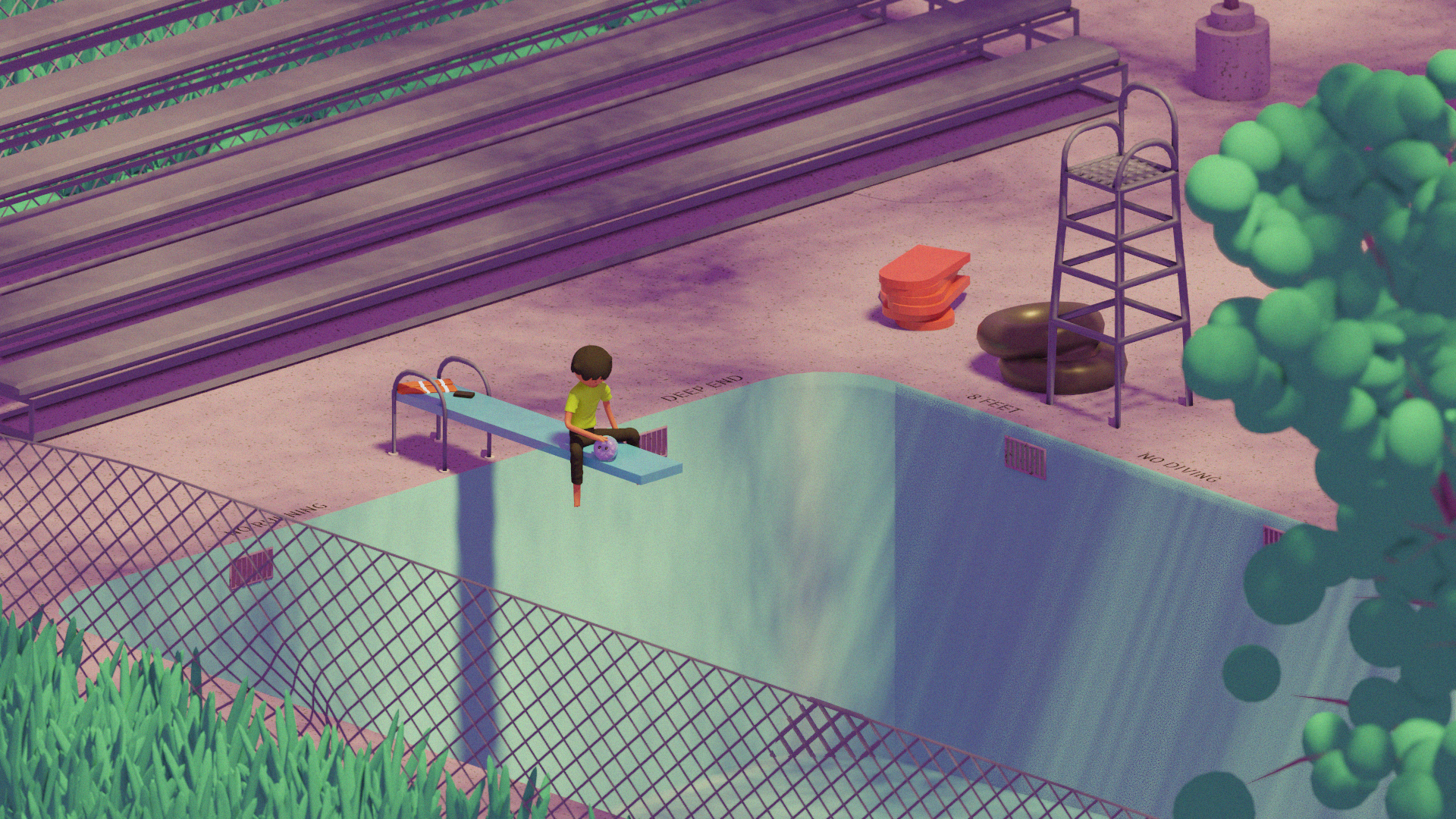
Animator Julian Glander is the definition of a multi-hyphenate artist. For years he has used his distinctive 3D animations made in Blender for projects ranging from New York Times illustrations to Adult Swim short films.
For his first full-length film, his squishy, shiny, vibrant creations were only part of the equation. He also wrote, directed , and produced the film, along with creating the songs (yes, he made that too).
With such a singular and unique vision, it’s difficult to compare Boys Go to Jupiter to other films. Much of the cast aren’t voice actors- bringing in a unique yet realistic and sardonic cadence to the characters’ way of speaking that isn’t often depicted in animated films.
Jack Corbett, the host of NPR’s Planet Money TikTok account, infuses comedy into his breakdowns of economics for his day job. Now as Billy 5000, he brings his humor to a character determined to make quick cash by taking advantage of the capitalist system.
Through his aimless teenage characters in suburban Florida, Glander lets surrealism take over what could be a normal coming-of-age story. The stunning animations combined with some (quite literally) otherworldly elements coalesce into a film that is as fascinating as Glander himself.

Culture Flux: So I first of all want to say I love this film. I felt like it was so unique. I haven’t really seen something like this a lot in a feature film.
I want to ask, you’ve worked on so many projects in your career, but with this being your first feature film, how was the process of making that different? Did it feel daunting to make this?
Julian Gander: I think I was a bit delusional going in. I think you kind of have to be to do something like this. I’d just finished a 10-minute episode of TV, and I thought, “can I just do that nine times in a row and that would make a movie?”
What I would say is like, it’s a lot of work, but it’s possible to make a movie on your computer. If you think about it like lifting a giant boulder, it’s not possible. But if you think about lifting a million tiny pebbles and carrying them across a room, that’s more what it was like. It was just like doing 10,000 little tiny tasks until it became something.
And also because you’re so hands-on…
I’m too hands on, yeah!
Is it just who you are as an artist that you want to have creative control over everything?
I think, yes, we’re getting right into it [laughs]. I think this is a common personality type with animators, a sort of obsessive controlling person. I think it’s one of the promises that draws people into animation is the idea to be the master of space and time, the idea to make everything exactly how you want it.
Unfortunately, yes, that’s my curse in life. And I feel lucky that I have found some healthy outlet for it.
You said that Florida is weirder than anything you could have made up. I guess living in Texas, I have a similar idea of the South. There’s like a weirdness behind it.
So do you think that the experience of living in Florida as a teen has helped overall shape the surrealism in your work? Because despite that how otherworldly your movie becomes, you feel like you were able to pull from a lot of those experiences?
I do! It’s been so long since I was back in Florida. I think it’s been more than a decade. And I kind of think letting it marinate in my mind and turn into a fantasy place makes it even more fun to think about and write about.
Florida is a place where it feels like anything is possible. And I think that’s true in the magic of Disney World where that’s the promise, is magic is real. Anything’s possible. It’s also true in the “Florida Man” news stories and in Scarface or the Bad Boys movies. Yeah, I don’t know. It’s a great playground for writing.
When I think back to Florida, I think of myself as a teenager in like black, skin-tight girl’s jeans, like sweating my ass off every day. Just being hot and muggy is really the only thing that I really remember, and I think that does come across in the movie.
Were you thinking about those archetypes of Florida when you were creating the screenplay and the story?
I think what’s one thing that defines Florida to me, and it’s certainly something you see a lot in the news and in pop culture, in many ways, it’s a state without an identity or without a history. The story of Florida is that it was obviously swampland and it was Native American land and that people really came down and started moving there at the advent of air conditioning. So it’s very new.
And as a result, there’s a lot of clashes, a lot of people fighting over what Florida is. You know, there’s this sort of Ron DeSantis Florida that’s even newer than when I was there. There’s Walt Disney’s Florida. Yeah, there’s Scarface‘s Florida. And then there’s old people who retire there. It’s everything and no one really has any claim to anything.
So it’s a lot of just kind of different ideologies bouncing on each other. And I think in the movie, characters are very quick to sort of plant their flags and tell you what they believe in or how they see the world as a result of that.
I feel like you somehow managed to successfully fit aliens, teenagers, capitalism, gig economy, all of these things in the same movie and make it fluid in a humorous way. So was it a challenge to balance the humorous aspect of the film, but also the fantastical elements with the real world commentary?
I don’t know, I guess. It was just, it was more that originally as I was writing the script, I was just using that document as a place to work through everything that was on my mind and just try to organize my thoughts on the world. And it’s yeah, I mean, balance is something that we’ve talked… my producer and I talked about a lot throughout the movie- balancing “how crazy is this part?” You know, “are the colors too crazy here? Is the voice acting so high up here that we need to bring down the animation?”
I think it’s like making a soup or something where you just, you keep playing with ingredients and toasting it.
And I think one thing that’s great about working independently and self-producing and self-financing is like, you can reconfigure things all the time if they’re not working, or if you want to try something new. We changed the ending a dozen times in the movie. And I don’t know, I really love that. And all the stuff that people have really responded to in the movie is stuff where we were just like, “what the hell, let’s try something crazy in this scene!”
So it was really like, I guess, categorizing things, compartmentalizing them and breaking them down into smaller pieces one at a time. So did the idea that you originally had for the film at the beginning change a lot to what the final film was?
Yeah, I think like the ending changed a lot. I don’t want to get too spoilery, but I think it’s a pretty out there ending. We had originally written something that was a little bit more neat and tidy, coming of agey. He learns a lesson, but, you know, keeps going with his life.
And I think one big part of the process was getting rid of that sort of invisible development executive on my shoulder, you know, from so many years of working in TV, just telling me how things had to end. And it was, at some point, we were just unshackled from that, and we felt like we could do whatever we want. And so I guess like the evolution of the movie was that it just got crazier and crazier.
In a good way. Yeah. So the voice actors have a much different cadence and tone than what’s normally presented, especially in an animated film. So how much direction did you give the actors ahead of time for their performances?
Yeah, I think that’s a good way to put it. The only real mandate that I gave people was, “we’re not doing cartoon voices,” or “I don’t want you to do a voice” was something I kept saying. Even for people who have been in a lot of movies and TV shows, we really listened to them more on podcasts and interviews when we were trying to figure out where everyone’s voice fit into the movie.
I think that naturalistic way of recording voices is really refreshing, obviously, in animation. It’s also really nice to work with, because there’s no accent for a special thing that someone’s doing that they have to keep track of along the entire process, because that can fall apart. I put together this dream team of people who I just really admired, both for their voices and performances, but also for their ways of seeing the world and the way they think about things.
You know, the cast list is a list of 15 performers who are also writers, directors, bloggers. You know, Jack is an economics genius, and so they really gave a lot of added value going over the script with me.
So was that the appeal of using more people who may have been actors or personalities, but not necessarily known for being voice actors? Is that part of the appeal for it?
I think it wasn’t like tactical at all. I think it was a bonus that came in. It was more like these were people that I really wanted to spend time with.
Some of the cast I had sort of like been friends with on Instagram or a friend of a friend, and I almost felt like it was like when you have a party, and that’s your chance to reach out to someone who you kind of know, who you want to get to know more about. So very selfishly, I wanted to hang out with Chris Fleming, and that’s why I asked him to be in the movie.

Music plays such a big part in this film as well. I was so impressed that you actually came up with all of the songs for the film. I’m just… everything that you’re doing, I feel exhausted just looking!
[Laughs] I also feel exhausted.
So how much, how far into making the film did you start working and constructing the songs? Were they there from the beginning?
It was pretty late. I think a lot of times people think of animation as a very big, industrial pipeline-oriented thing, where it starts with the story outline, and then it goes to storyboards, and each technician kind of comes in for their part and does something, and it keeps moving.
And whenever I’ve worked that way in the past, I always felt I was putting together IKEA furniture or just following instructions, and I really wanted to leave things open in the process that we could come back to and find ways to breathe new life into the project.
So in the script, all the musical moments just say in brackets, musical moment here. And it was just something we played around with very late in the game where we were watching the movie and saying, “what do we need right now?” You know, what’s going to bridge these two scenes or what’s going to get us in Billy’s point of view?
And then I think the cast like really stepped up in terms of singing those songs. Mia’s song is obviously very beautiful. That is not that surprising because her voice is beautiful, and she always makes beautiful music.
But Grace and Jack really surprised me with how much emotion and character they put into it. And I think a lot of people leave with the lasting impression of Grace’s egg song more than anything else in the movie.
And was it a similar thing where you didn’t give them like specific direction, I guess, you just let them kind of feel what they were feeling from the script and the characters?
Yeah, with Jack, we really had to… we were in the booth just figuring out physically how he wanted to sing it, you know, what was possible in his range, because it’s different from my range where I wrote the songs.
And with Grace, I had sent her the song “True Love Will Find You in the End” by Daniel Johnston, and I said, “I want this kind of raw, unskilled singing and guitar playing, where it really just feels like it’s pouring out of you.” And she said, “I don’t think Freckles would listen to Daniel Johnston, I think he would listen to Machine Gun Kelly.”
So we recorded it the Machine Gun Kelly way and it’s perfect!
Can you talk a bit about the character Billy? Because what I like so much about him is that he’s not perfect, but he’s not a villain. He’s kind of this teenager that’s trying to find his way.
And I feel like a lot of people can relate to that, so how much of yourself did you input into him in this character? Was that the one that you felt is the most personal to you or are they all equally personal?
I think I’ve definitely spread myself across all of them. Billy started out, there’s elements of me in there, but it’s really Jack. It’s really his view of economics as this sort of life force and this constant calculation that he’s doing that informs Billy and some of the sequences, like when he’s explaining this sort of currency exchange that he’s doing, that comes really straight from how Jack presents things on, for example, NPR’s Planet MoneyTikToks.
So that character is sort of a marriage of us. I sent Jack the script and he wrote back right away and said he felt like it had captured his life. I didn’t know this, but he was a pizza boy in high school, which is just so perfect.
And his way of just, I don’t know, his way of seeing the world is like, it’s so in the character. It’s so hard to imagine anyone else doing it. Yeah, it’s Jack. It’s kind of more Jack’s thing, actually.
Can you talk about the animation you saw growing up that had a lasting impact, like especially inspirations that combine this unique visual style, but also this creative storytelling at the same time, whether it’s film, video games, you know, any medium?
Yeah, I, a lot of people have been making reference to the fact that there’s sort of a video game look to the movie. I wasn’t really allowed to play too many video games growing up. So I think that made them a little more sacred and special to me when I could play them at a friend’s house or even at school.
One game that I had was The Sims, which has this sort of top-down look at the world, obviously, that’s throughout the movie. And of course, any Sims fan will know that “Rosebud” is the unlimited money cheat code in The Sims.
I literally just played Sims 4 yesterday, so it’s so funny…
Oh, that’s awesome. I’m not letting myself get Sims 4. I hold up because I get so addicted. I can get addicted to any video game, so I have to really watch it. I’ll get addicted to a little Candy Crush, a little whatever it is. It doesn’t even have to be fun.
It’s those games that don’t have an end to the story.
That’s what it is! That’s how they get you.
Absolutely. So, yeah, they’re actually making nowadays a lot of adaptations of video games. You have Death Stranding coming up, which is crazy.
So do you think about like relating to your film to a video game in any way? Because you said you didn’t grow up with them, but you did have The Sims inspiration. So you kind of like the idea of merging like video game work that you’ve done in film?
I think that there’s a lot to explore aesthetically. I think there’s so many ways to make an animated movie and it oftentimes feels the big animation studios are each locked into one style or one specific way of looking at the world and I’d like to see more. I think in the world of indie video games, you do see a lot more experimentation visually and new ways of showing things because each game tries to do something new mechanically.
I think for the story of the movie, this really fits because it’s a story about how the gig economy has gamified our lives, has kind of turned us all into NPCs over the last decade or so with our willing participation and how this sort of the very audience-friendly cartoony allure of a lot of this stuff can be the intoxicating way in for on-demand apps that end up ruining our lives.

Absolutely. And I know that you made this movie in Blender and I was thinking about Flow because that became such a successful movie made in Blender. Obviously a very different visual style, but how do you feel about the accessibility of animation tools and how that’s affected your artistry over the years?
Yeah, I couldn’t be happier just as a fan of animation. I mean, obviously when Flow won the Oscar, I was screaming.
I was like, “that’s my software! That’s my computer program up there at the Oscars!” In many ways, I think this is the promise of the internet was that we were all going to get technology that democratized things and that we were all going to have everything in our hands.
I think animation is maybe about to have a moment similar to the moment that live action had 15 to 20 years ago, where all of a sudden everyone had a DV camera and everyone could make a movie. We saw a lot of really great stuff out of that and we’re still seeing echoes of it now.
I love all animation. I love big studio animation and classic animation, but what I really love is when animation is personal and just as a fan, I would like to see one movie like this come out every week. One personal, small, weird animated feature every week. There’s enough people out there that know how Blender works that I think we could do that.
Also, I feel like it gives the movie more of a personal style because the similar thing where it was animated by the same person who wrote the story and obviously in something like Pixar, that’s normally not going to happen. Do you feel that idea of having more creative control over it does improve the personability that a movie has?
I don’t want to say that it improves it because again, I do love Pixar and I think they’ve built a truly incredible machine for delivering emotion and stories. What I used to say is, what if an animated movie could be like a novel? What if it could be just one person pouring everything into it and what would that feel like?
There’s intangible elements to it. We recorded 50 hours of voiceover and then I had to be the person in there cutting out the “ums” and “uhs” and the room noise to get it exactly right. That was a very hard two or three weeks of the process, but I felt like I had to do it so that I could know the material well enough to serve it later on.
I want to thank you for your time today. As my last question, I want to ask about your art style because it is so unique. Did it take a while to figure out your visual identity and what that would look like?
Yeah, I’ve been using Blender for about 12 years now and it actually kind of came to me very quickly once I started using it. I think what I’m really drawn to are shapes and designs that feel very honest and clear and what I really like about somebody that’s just a body that’s just made of circles and triangles is you can see it and see how it was made and I think it’s a very sweet way to tell stories.
I’m often pushing up against the limits of my little laptop because Blender is an incredibly powerful software but I’m on a MacBook and it gets hot if I try to do the sort of hair and feathers that you sometimes see in 3D animations.
I think that’s what it is. It’s the marriage of technical constraints with how you get around them, I guess.
Kind of the combination of technical but art as well.
Exactly! That’s when you can get in that sweet spot. That’s all you can hope for.


Leave a Reply