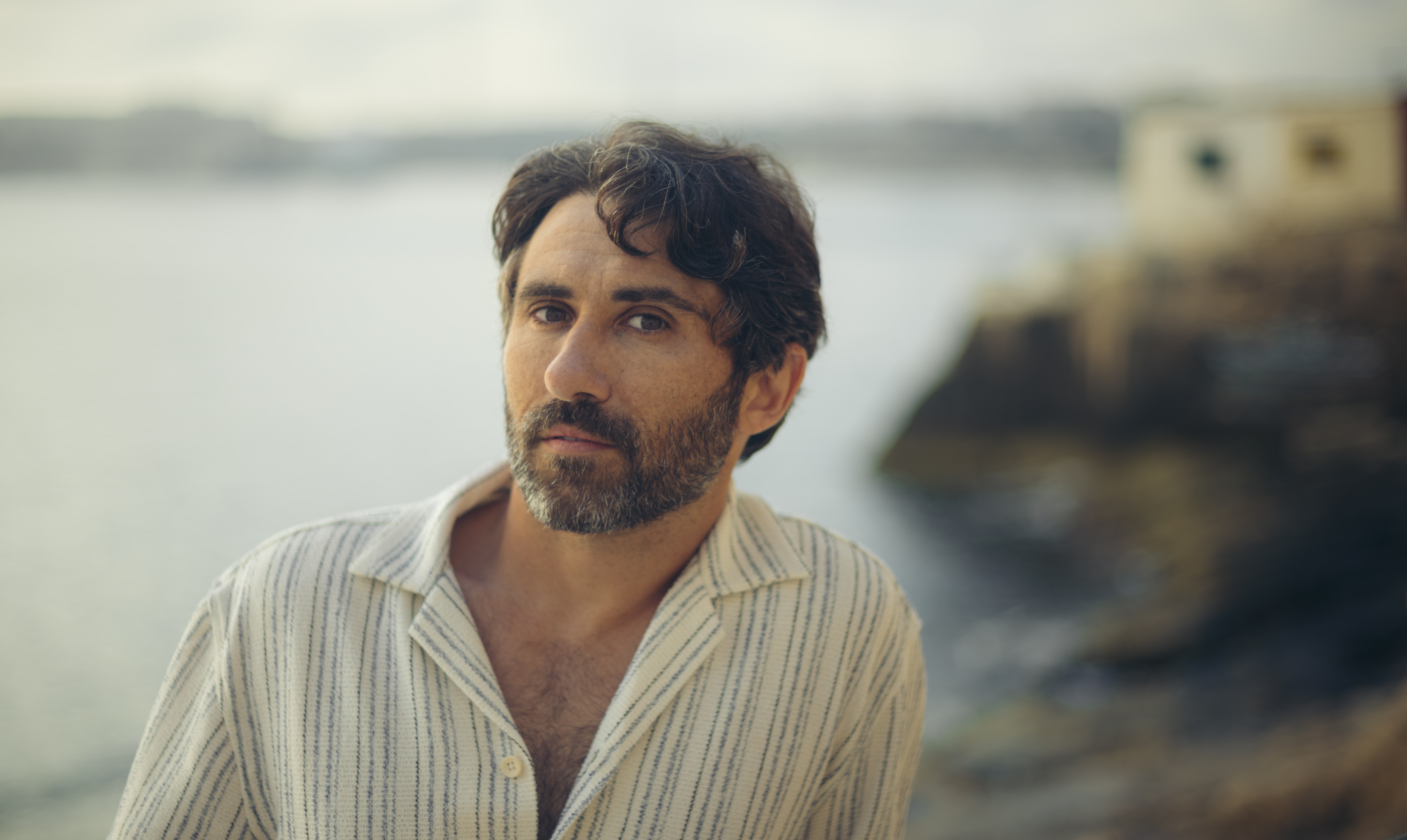
After attending drama school in London at the Mountview Academy of Theatre Arts, British-Maltese actor Joe Azzopardi has performed in theater, TV, and film roles throughout his storied career. From Shakespeare productions to Jurassic World: Dominion, Azzopardi’s varied roles in both the UK and Malta productions that now led to a film that feels kismet: a continuation of the British story of Enola Holmes set in Malta.
Enola Holmes 3 centers on Enola (Millie Bobbie Brown) preparing for her wedding in Malta, only for Sherlock to go missing. Azzopardi plays the mysterious Mikiel Mizzi, whose true intentions for helping Enola are initially unclear.
“This movie was kind of like both my cultures coming together in this really beautiful way,” Azzopardi says. “I kind of felt like all the stars were aligned for me to just like roll into this character.”
In a conversation with Culture Flux, Azzopardi shares how his Maltese roots helped portray his character, the influence of his theater background, and what made Enola Holmes 3 such a special project.
Culture Flux: So I first wanted to ask you a little bit about your background. I know that you went to drama school in London, so you were really able to hone your craft in theater. So was film acting always a goal for you when you were in drama school?
Joe Azzopardi: It was actually, yes. I mean, from a young age, I was a film buff my whole life. My father was really into films and he brought me up watching lots of films, probably a lot of films I shouldn’t have really watched at that age, but still went through them.
I was just fascinated with actors and their craft. So yeah, I went to drama school in 2010, I believe it was. I had an amazing three years there and I really, really learned a lot.
I didn’t just learn a lot at drama school, I also learned a lot about life in London. I grew up kind of between England and Malta. I probably predominantly spent most of my time in Malta, but it’s quite a safe cove, Malta.
And then you come to like the big bad streets of London, you kind of need to wise up, smarten up. So yeah, it hardened me up, London, as well as kind of taught me my acting craft. And the rehearsal, and those usually what you learn because it was a theater school.
So I feel like the rehearsal process that you go through for theater is something that’s really important to then take into film, because it’s kind of like you need to do that whole like four, six-week rehearsal process in your head before you step on set day one. It’s kind of like a lot of background work that I wouldn’t have known unless I did do the theater training.
Did you do a lot of background work for Enola Homes 3? Were there things that you learned on your own for the character?
There was, there was a lot of historical work actually. There was, yeah, to be honest, I didn’t have a lot of space. I got casted quite in a short amount of time for this.
I didn’t have too much time right before to do my research on it. But luckily enough, I knew a lot about Maltese history. I know a lot about like when the British were in charge of Malta, about the colonialism.
So thankfully all that stuff was already in me. And then yeah, we’re doing some, then it was just about kind of like spicing up my character a bit. And yeah, making him a bit of a, this Victorian era 007-type guy.
Well, that’s been a really fun part of it is that your character is kind of mysterious, and so you kind of get to play that middle of the ground character.
Exactly, yeah. You’re not quite sure where his allegiances align in the beginning and even when he first meets Enola, she got to suss him out and she might think that he might’ve had something to do with her brother’s disappearance.
But yeah, I won’t ruin it for you in case you haven’t seen it. But then as the film goes on, you get to understand him a bit more.

What was the audition process like? You said it was quite quick. So were you given a lot of information about the character leading up to the audition?
How much did you know going into it?
It was quite good. Thankfully, I had managed to meet Phil Barantini while he was location scouting in Malta beforehand and he had discussed the character with me.
I think me and Phil shared a bit of a special connection because my mother’s from Liverpool and Phil’s from Liverpool. And also the fact that I’m half English, half Maltese, this movie was kind of like both my cultures coming together in this really beautiful way with a guy from Liverpool at the helm as well. So I kind of felt like all the stars were aligned for me to just like roll into this character.
And yeah, I sent the audition through and they thought I was the one for it. I really felt like, I don’t know, it’s brought me a lot of patriotism and national pride as well. The fact that I could deliver a performance like that as well for Malta.
I would say it must be like quite a singular experience to be able to represent Malta in a big film like this because you don’t get to see it represented much.
No, not at all, unfortunately. Well, I mean, Malta needs to go through this process of doubling up for other countries, to get the film work in and get the experience and then we kind of needed to start getting people to mention Malta in the story, until now it’s like films are fully set in Malta. And it was beautiful seeing my country as this background of this classical English piece.
Were you able to share a lot about your culture with people while you were on set? How much time did you have to really share that with people?
I did, it was shot in the UK for about three or four weeks, I believe it was at Shepperton Studios. And yeah, I had to, I was got asked a lot of questions about back home, a lot about the language as well, about how to kind of like… and even you never hear Maltese spoken really in these big films either. And I was throwing and ad-libbing Maltese lines to throw in and they were loving it.
They just wanted it to feel authentic to Malta as well as to the piece.
So did you feel like you were able to give kind of a little bit of, I don’t wanna say you were a consultant, but do you feel like you were able to give some kind of representation and kind of suggest things to the director? Were you able to do that?
I did from my performance standpoint and about Maltese culture, but I’m not gonna take any work away from the incredible work that the art department, the costume department and all those guys did. They did, I didn’t need to tell them anything. They didn’t ask, but I would have needed to tell them anyway because they did such a fantastic job.
Honestly, this costume design, the set design, it was all authentic to the time and styled so well as well. So no, that was all those guys.
So when you went on set, it must’ve felt a little easier knowing, feeling like you were really in that time period and you really felt ingrained in that time.
Funnily enough, when we were shooting at Shepperton Studios, it was a bit crazy because I kind of walked into these old Maltese palazzos and stuff that like, rooms that I would walk in in Malta and it just felt so authentic.
I literally just felt like I was in Malta even though I was in the studio in London. So much so that even when you looked out of the window, they surrounded the whole studio with a backdrop of like the Maltese cliffs and the Maltese countryside. So even when you look out the window, you feel like you’re in Malta, it was crazy.
What was the process like of creating this film than different projects that you’ve worked on? Was it different? Did it feel different when you were doing it?
This one felt very special to me. Yeah, yeah, it did feel different from all the rest. I felt a lot more stress-free.
It felt a lot more of a family feel. Sometimes when you work on big films, there can be so many people that you kind of never really meet anyone. You know, there’s some people you won’t even meet until you wrap the film.
And this one, we just, everyone knew each other. The social life off set was amazing as well, because in Malta, as soon as you wrap your day and it’s boiling, you’ve been working in the sun all day, “everybody go to the beach, let’s have a swim.” You know, “let’s unwind,” it’s just, it’s island life.

And I wanna ask, what is your experience like shooting in the UK versus, you said you worked in Malta as well. So is there a big difference between acting in roles in Maltese productions versus British productions? Are they similar or very different?
I wouldn’t say so. Obviously there’s a lot less money in Maltese productions. So I wouldn’t say you would maybe get looked after as much, but from an acting standpoint now, I mean, you know, my craft is my craft.
I kind of, I would prep a character and give it the same, give it like the best work ethic I could in any regards. So it wouldn’t really matter if I was in Malta or London, but in terms of like the sets, yes. I mean, there’s not much of a Maltese cinema scene over here.
I can, there’s probably maybe like 12 Maltese movies that have ever been made. They’re picking up slowly, slowly. They’re starting to get a bit more money to actually fund films now, whilst we predominantly, I think in Malta, have been focusing on servicing these big films to teach us, but now it’s time to put all that, all everything we’ve learned into actually creating an indigenous film industry now.
And what do you think you’ve learned from this role that you’re going to take in future roles and apply it?
I’ve learned how to do a lot of work, but then soon as you get on set, just keep that all at the back of your head and have fun with it. Honestly, I learned that a lot from Millie Bobby Brown. We discussed the character a bit beforehand, you know, we did our minor work, but on set, it was kind of like, it’s like being back at drama school, being like, “okay, let’s play!”
“Let’s try this. Let’s do this, let’s do this,” you know? And that was a breath of fresh air. I loved it. And it’s obviously about hitting it with confidence as well.
Are you able to still take so much of what you learned from drama school and theater and apply that to acting in film?
I would say so, yeah. Yeah, obviously I think the lessons I’ve learned from not just acting on set, but even working on sets, because I’ve produced two films as well myself. So I know stuff from the production standpoint.
No, so I would say my experience of what I’ve learned so far has probably been more beneficial. Obviously I think the base of what you learn at drama school, you need to break that. You need to study some Meisner, you know, in some of the different acting techniques and find what works for you.
But then once you’re actually on set and it’s not just about acting when you’re on set as well. There’s like an onset etiquette that you kind of have to carry with you when you’re on set. You need to kind of know where to stand, where to be.
You know, you can’t just run off to the toilet and have a five, 10-minute conversation on the phone somewhere off set. You know, you need to let someone know where you are. There’s all these kinds of little things that just make you a really good professional at the end of the day.
What was the biggest surprise when you started working more in film? Was there something that kind of, maybe not shocked you, but was very different that surprised you at first?
How much waiting there was! Obviously acting is 80% waiting [laughs]. And yeah, 20% doing it just takes so long to get through things. So yeah, it was keeping yourself occupied while they’re setting up a scene.
I’ve heard that from a lot of people that you do more waiting than actual acting and everything. So I guess there’s patience that you have to learn as a skill as well.
Exactly! Sometimes, you know, a lot of actors just like to go sit in their trailer and do their own thing. I like to kind of be on set and chat to the crew and just kind of like help the day go by a bit more, hit it from a more social side.
I imagine you got to build a lot of camaraderie though, if you have those periods of downtime on set.
You do actually, you do. That’s why, I mean, when you film a film, you’re spending 12, 14 hours a day with these people sometimes. You hang out with, and for you to shoot a film for three, four months, you hang out with these people more than you hang out with your own family sometimes.
So at the end of the day, you form very big connections with them. And yeah, it does, the social life helps as well, yeah.
Do you feel like you start to lose your skill when you haven’t done a role for a while?
I would say you do actually, you know, funny enough. I think there’s a, or at least kind of that first rehearsal might be a bit, oh, kind of like getting back into the swing of it.
But what’s good about actors is if you’re lucky enough to get frequent auditions, you’re always practicing your cross because every audition, you’re not just reading the lines at a camera, you know, you’re getting into it, you’re coming up with the voice, coming up with things, you’re creating a whole character for, you’re working on it for a whole week, present it, then you move on to the next.
So thankfully, if you do the auditions, it’s like you’re always practicing.

For Mikiel, what was the biggest challenge and what was the easiest part of this process of becoming this character and shooting?
Honestly, the hardest part might have been shooting in the heat, because it was very, very hot when we were shooting in Malta. I remember obviously wearing Victorian era costumes that were pretty thick. So that was a bit of a struggle. You kind of felt like you were in an indoor sauna sometimes.
And the easiest part, God, I don’t know. I honestly think it’s probably the comedic aspect of the performance, you know, just something really fun and jovial. I just feel like I’m so at home when I do that and I love it.
Was there anything new you had to learn for the film, whether it was physical or something like that?
Yeah, some stunts, actually. It was quite stunt-heavy, my character, and I did most of them, most of them were my own stunts as well that I did. So it taught me a lot about work doing the stunts with such a big actress as well, because obviously I don’t want to be throwing Millie Bobby Brown over and have the potential of it going bad.
So that was actually a bit nerve-wracking, that kind of just making sure that I got this stunt right, I wasn’t going to hurt anyone, I wasn’t going to badly injure the main actress of the film [laughs].
So did you feel like, that was probably a challenging part of it too, was the physicality, right, of getting that right? Because on one hand, you have to make sure that you’re making the right expressions, but your body also has to be following that as well. So going into the film, how much rehearsal is doing the stunts versus more of the acting and emotional parts of the scene?
The acting and emotional parts of the scene, I mean, it depends which director you’re working with, but I like to not do much rehearsal. I kind of like to, when we meet up on set, we kind of just walk through the scene, because I kind of, I don’t say I’m from the belief that your first take is your best take, but I know a lot of people do believe in it, and I do value that first take, because it’s the first time you touch that glass, it’s the first time you speak to that person, it’s the first time you’re going to see what that person you’re acting across is going to give you, and you want to have some genuine surprises to it.
So yeah, I wouldn’t say I like rehearsal too much, I kind of just want to see, I learned that from Ridley Scott actually. He believes that an actor’s first take is his best take, which is why he likes to cover it with so many cameras, because he shoots it with like seven or eight cameras sometimes, and he’s like, “if he’s going to give me his best performance on his first take, then I’m going to give him my best by covering it so he doesn’t have to do it again.”
It’s nice because you have that versatility of having that experience of rehearsal on stage, but also being able to do it in a quicker pace as well with film. Working with Philip, what was that like? Was that a different process? How much conversation did you have about the character before you were able to actually start shooting?
Yeah, we had a few chitchats about him, about the character beforehand. I just loved working with Phil so much. Philip was such a man of the people on that set.
He’s a very nurturing director. He’s very kind of caring of your performance and that everything is okay with you. And he just creates this very, very zen vibe on sets.
Kind of, he’ll give people a hug in the morning. He’s like, he won’t lose his temper at all. He’s honestly, he’s brilliant.
I had the best time working for him and I have a lot of respect for him, not just as a director, but as a human.
So I want to ask as my last question, what do you hope that audiences take from Enola Holmes 3 and that experience of watching the film?
I hope that they see how beautiful Malta is and that they should probably come give us a visit sometime because I think from all the films that have ever been shot in Malta, I don’t think anybody has done such a good job as Enola Holmes has in showing us like raw, rustic and natural beauty of the time as well, you know? So for me, I was just happy that my island looked just so pretty.
Enola Holmes 3 is now available to stream on Netflix.


Leave a Reply