
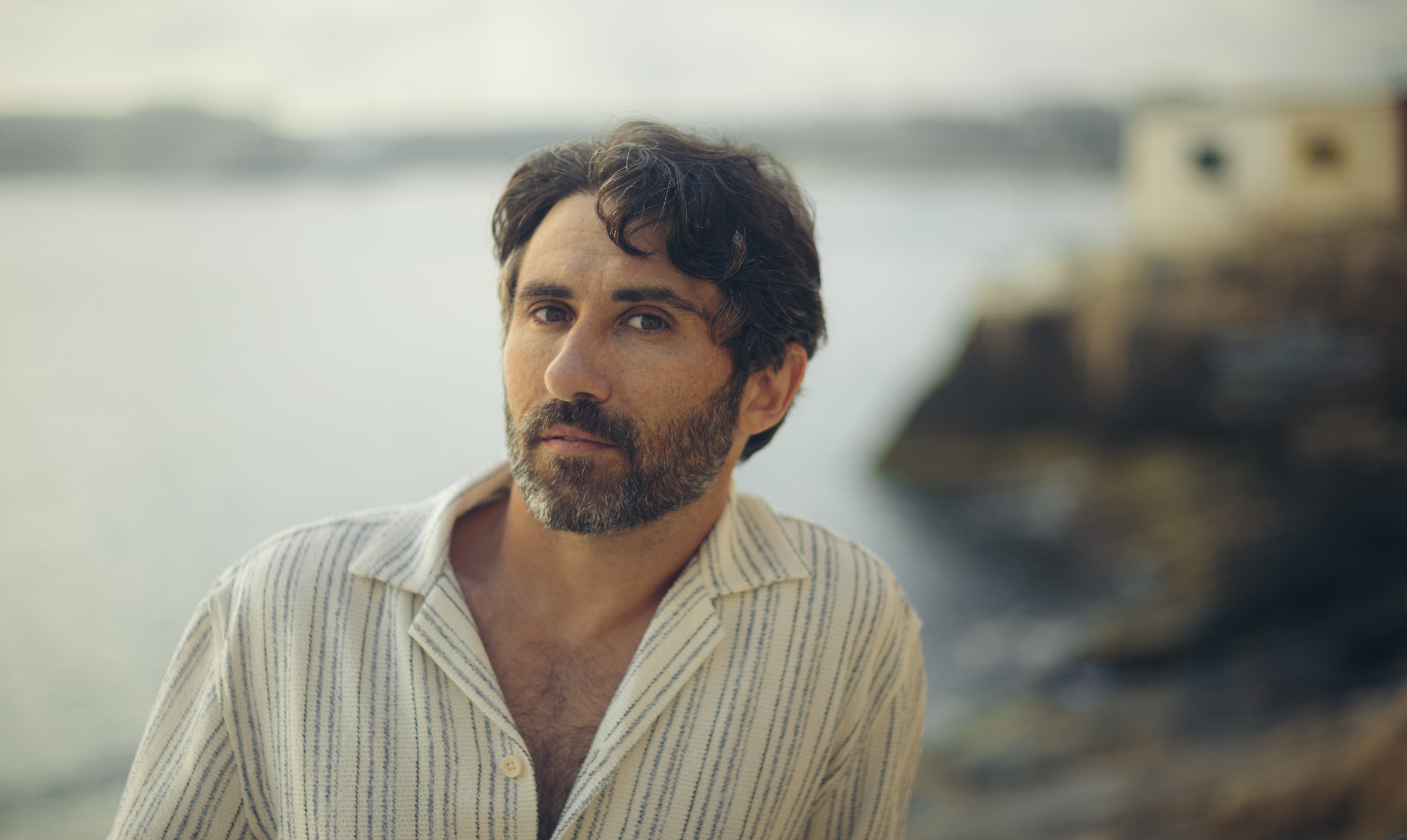
There’s no secrecy to joan’s love of pop music from all eras. From the 2000s pop intro of “so good” to the modern production of recent single “heartbodymindsoul,” there’s also a catchy chorus or infectious beat to latch on to. Speaking to Culture Flux backstage before the first night of their supporting slot for Misterwives in Fort Worth, Texas, Alan Benjamin Thomas and Steven Rutherford detail their perspective on the Little Rock music scene, movie inspirations, and journey to discovering pop.
Culture Flux: How has your musical taste changed since you started getting into it younger and started getting into bands versus now? Do you feel like you just listen to a wider variety of music, or has it progressed in some way?
Steven: I started in metal, so it’s changed a bit since then. My first memories of listening to music were like, AC/DC and Metallica on the way to baseball games. Then whenever I was in fifth grade or fourth grade, me and my brother started a metal band. I was literally in a metal band until high school, and then I found pop and it was like, “this is the coolest thing I’ve ever heard.” Went all the way back to Don Henley and Prince and all that. Just the history of great music in the pop world… I literally had no idea until college.
That’s interesting, because I feel like it’s the other way around normally. I’m a metalhead too, but I listened to top 40 growing up, like Britney Spears and NSYNC.
Steven: What’s crazy to me too is a lot of people that kind of came up in the metal world are producers in the pop world or songwriters in the pop world. It’s crazy how much crossover has. It’s not at all what I would expect to be as far as crossover.
Alan: I grew up with what my parents were listening to, which was pop country all the way to like, Bob Seger and Prince is still my dad’s favorite artist. So I had a taste of older pop, but when I really started getting into music, it was more emo. I was super into Dashboard Confessional, Thursday, and Get Up Kids, and Death Cab. It was just that kind of indie rock bend, and that’s where I started writing songs. My original songs were not good. Very wordy songs. I was using a thesaurus to make my songs sound way smarter than I am. Then, I really got into pop, probably after I moved to Nashville. I live there for just a couple of years. Now I’m just obsessed with it.
And also, pop can truly translate into anything because it’s the simple structure that is in anything, really.
Alan: The most all-encompassing genre in my opinion, because you can have a song that is a rock song, but there’s a pop melody, and that’s pop, or a hip hop song that has a pop melody, and that’s kind of hip hop and pop. It’s such a blending genre.
Steven: Even today we were listening to an interview with Rick Rubin and he was just talking about the Beastie Boys album, and obviously there were like three songs off that record that just took over the world. That’s like, punk guitar and 808 drums, and rapping, and basically, like, yelling over it. And it’s just like, that’s the most beautiful thing to me to be pop. It’s just literally a blend of everything slammed into one album and being like, “alright, this is going on the radio.” I love it, I think it’s so great.
Well, you guys do a good job because I can hear the different decades of pop music in yours. I can hear a little 80s, a little 2000s- because I grew up on that- and all of that. You recently release the single “heartbodymindsoul,” and the title comes from when you guys were in Asia, right? In Thailand, having a massage, and you heard that phrase. So I’m curious, is there any other inspiration you get while touring for songwriting? Whether it’s a phrase or melodies.
Alan: We don’t stop. We’ve done a really good job of trying to separate. Like when we’re home, we have a studio now, so it’s kind of a 9 to 4 or 5 day job. We treat it like that, but when we go home, as much as we’re present with our families, he’s still writing. He still thinks of a phrase and writes it down. So, even at home that happens. Out here, totally my voice memos are just full… just trying to get to a quiet place. So yeah, I think all the time.
Steven: Yeah, I think one thing that both of us are really good at, if we can toot our own horn, is we try to be as intentional as possible at archiving at the time while the idea happens. For lyrics, a lot of it is like, I’m watching a movie and I hear a phrase that I just think is brilliant, and I want to do our own take on that. For him, it’s more melodies or whatever. It doesn’t necessarily matter if it’s on the road or if it’s in the shower, or whatever. I think we just try to make sure to jot it down so whenever we do get back to the studio, we can shred.
What are albums that you’ve listened to a lot? You’re absolute favorites that you can put on again and again and not get tired of?
Alan: I can put on James Taylor’s greatest hits album… which is funny that the greatest hits is my favorite album, but it’s got all of the greatest hits (laughs). Coldplay’s Parachutes or A Rush of Blood to the Head, because I can listen to it top to bottom and never get sick of it. Death Cab for Cutie. Any of their early stuff, but specifically Transatlanticism.
Steven: Mine is Dawes’ We’re All Gonna Die, maybe my top album ever. The new Medium Build record… I’ve listened to probably four or five times, which is a lot for me. Uncanny Valley by Coin. I listen to it a lot, they’re buds. I just think that album is perfect. It’s just front and back amazing.

What kind of music are you listening to when you’re driving on these long drives?
Alan: Today we listened to the new Coldplay album…
Steven: It’s a big thumbs down.
Alan: Didn’t really like it. I’m like, their number one fan. I just didn’t love it. And honestly, a lot of podcasts.
Steven: We listen to a lot of podcasts.
Alan: We like comedy podcasts… and music podcasts, like production, and technology, and all of that. There’s a big tie-over between how stand-ups and comedians, comedy writers, think about writing, and the way I think a song is written, so it resonates with both of us. And we like to laugh.
It might be kind of- I don’t want to say annoying- but maybe you wouldn’t want to listen to music all of the time when you’re playing it too.
Steven: That’s totally it. Especially at home, also on tour, but especially at home where eight hours a day we’re just listening to our own song…
Alan:.. Our own vocal, singing back to us. Just listening to the same line over and over again, then also our own songs that we’re making. It’s usually nice to not listen to music.
Steven: I think a lot of the times now we listen to music more as a way to feel inspired or a way to research kind of different sounds or songwriting, whatever. I very rarely listen to albums more than once, so it’s one of those things where I listen to it and I’m like, yeah, I love that, I get it. I probably won’t listen to it again because I just don’t feel like I have the capacity to take in our music and more music.
Alan: I’ve never been offended, but I can tell when a friend who also does music hasn’t listened to our new thing. You can just kind of tell by their language- it’s kind of vague. Then there’s a part of me that’s like, “oh, why wouldn’t you listen to our music (laughs)?” And then I think of all my friends that make music that I felt like I haven’t had the brain capacity to sit down, and there’s so much too. Then I’m like, “oh, I can’t get mad at that.” I’m not listening to theirs either.
I noticed that on your Youtube channel, you show kind of the behind the scenes of creating some of your songs. Have you ever felt self-conscious of showing that to people, or has that always been something that you’ve been really open about? Because some people are embarrassed by their rough drafts.
Alan: I don’t care anymore. I used to not love, like, “hey Steven, check this out (hums melody). It’s just me humming or whatever. That can be extremely embarrassing. We started a Patreon, and we started giving people, if they subscribe… we carve out time to just create content for them. These people are giving their hard-earned time and money to see behind the scenes. If someone is going to pay for behind the curtain, then I need to give them behind the curtain and kind of get away from the embarrassment of that. So, I would still say I prefer to have control over what we show, but I’m definitely not to the point where I’m only sharing a demo that’s like, demo. You know, it’s a demo. I have people expect it to not be perfect, so I’m less embarrassed by the stuff than I used to be.
Steven: And the videos, we’ve never documented from day one on songs, as far as having video footage of it. We have just hours and hours of working from the start of the song to finishing it, and it’s just too cool not to show, even if it’s one or two people out there, like: “OK, I see how they did that and how it connected there.” It inspires them to try to get their own songs done. So many people, they have to have a huge tier of people to finish a song.
And with us, it can normally just be us two from start to finish. So that’s kind of our thinking. “Let’s show people that it’s literally us doing this,” and it’s just us in a room, writing it, producing it, and finishing it. That’s kind of our thing is letting people in on that and hoping that it inspires people like it does us, because we watch videos like that all of the time. I remember the Justin Timberlake and Pharrell era, Justified, where it was just like eight hours of footage.
You’ve mentioned watching a movie and creating something from that. I saw that you did Say Anything- you made a song from that. So have there been other movies that you’ve either directly taken inspiration from or maybe the tone of it, or the music from it?
Alan: I probably say that more- tone is a good way to say it. We started writing with the intention of a licensing project, just to write songs for film and TV. I dabbled in that a little bit. I haven’t had any crazy placements at all. It was all small stuff. I was making a living doing it. He gets out of college and he’s like, “hey, let’s try this together,” so we did. The first day, we wrote what became our first single, like, “OK, this is more than just a side thing. We need to make this the main thing.” But the essence of what we were there to do kind of remained.
I want to feel the same thing I feel when he puts the boombox over the head and the song comes on- that Peter Gabriel song. I want to feel that on every song. I want someone to be able to place their own scene of their own life in it, or a nostalgic movie scene, or something. So, there’s something about cinema and music supervision that I think is so crucial. The soundtrack, or the sound design, so we’re constantly trying to recreate that feeling for people.
Steven: That’s probably the most direct one we’ve done so far. We didn’t sit down like, “hey, let’s sit down and write a song like ’Say Anything…’” then it just rolls and it works.
Now that you’ve had a lot of tours under your belt and a lot of international tours under your belt, what have been some of the most memorable live performances for you as a band?
Alan: We played the F1 Grand Prix in Singapore last year. That was very cool. We got to play two nights there, actually. Every Asia trip we’ve taken, I’ve been so pleasantly surprised that we even have fans at all, so that’s been really cool. We just got back from Australia for the first time. That was a nice surprise. I’d say any of our Asia tours. I have a crazy ton of memories from those, just such a different place.
Steven: Melbourne, specifically in Australia, was really awesome. Salt Lake City is always really great.
Alan: They’re crazy there, they love music.
Steven: Our last show that we did there, our headline tour for our album, was just one of the best shows that I think we’ve ever played. It was one of those ones where we were so dialed in good. There was no thinking about what we were doing. Everybody was just together on it. It was really cool.
When you work together, since there’s only two of you, do you usually agree on where the song is going, or production. Do you ever butt heads being that there’s only two of you, or is that not really a problem?
Steven: We’re pretty much on the same page all of the time. Usually if someone has a really strong opinion on something, the other one doesn’t have such a strong opinion… a little bit of push back, and if there’s push back still, it’s like, “OK, I think that…”
Alan: “…I trust your gut” kind of thing. My mentality is like, if he throws out a lyric that’s interesting, nothing’s final ’til you master it. If I need to live with it just to get used to it or there’s a melody that he’s like, “I think that can be better,” but maybe it is the best option, there’s always time to tweak until the end. It’s not worth fighting over unless it’s just super strong extinct, but we kind of stay out of each other’s lanes in a healthy way.
Did you connect immediately music-wise when you first met, or was that something you had to develop over time?
Alan: No, it was pretty instant.
Steven: We were in separate bands. I think at the time, both of our bands had differing views on where we wanted to go in the future. At the same time, we started writing for film and TV. Then literally the first session we did together was like, “oh, this is where I wanted my band to go this whole time,” and that’s where he wanted his band to go the whole time. So, it just kind of made sense.

So, you’re from Little Rock, and I feel like people have a misconception of what Arkansas is like, especially a city like Little Rock, which is a little bit more metropolitan. What are some of the common misconceptions you find about the music scene or the community that you have?
Alan: I think people obviously attribute Arkansas as a flyover state in a negative way. In some ways I understand that. Probably until the last decade, arts, entertainment- it was there, but it wasn’t a staple. Honestly largely because of, it’s crazy to say, but Walmart, and their investment in northwest Arkansas. There’s a crazy museum there, the world-renowned Crystal Bridges. We’re getting our food culture, just unique staples of Little Rock. I think that’s all been getting better. It’s a river city, so it naturally has a really beautiful downtown, like central Arkansas area.
Music, I’d say, is probably not much of a misconception. The music scene, in terms of doing it for a living is not big. I could not name probably on one hand how many bands I have personally that are touring acts that also aren’t working a different job just to make ends meet. I think that part’s not a misconception. There’s not the same kind of scene as like, LA or something. What I love about that though, for us, is that it’s a beautiful place to live, the cost of living is nice, we can afford to have nice houses. It would be insane in any other big city. There’s not that many fish in the ocean in regards to industry, so we’re not fighting for anyone’s attention in town.
People that know joan in Little Rock know it’s legit, it’s what we do for a living. We’re still anchored with our family there, so I personally couldn’t do the LA thing. It doesn’t appeal to me at all. I’d say the arts is getting better, but it’s not a thriving hub.
Steven: People always think that they’re barefoot, and everyone has outhouses. For some people, that does exist. And you know what? Good for them (laughs).
So how do you think, since you’ve started touring and making music to now, what is the biggest change that you’ve seen in the band?
Alan: We had a good conversation here just on expectations. I think five or six years ago when we started, we knew what we wanted, but maybe we were so new in the industry and kind of green that we were blindly following advice of our team. We trust them still, but I think now we have a very clear vision of what we want joan to be. That morphs as we grow and change and learn, but we’re a lot less scared now to have hard conversations and be like, “we’re not doing that.” I sometimes forget that bands are a unique thing in that your teams works for you.
A lot of times it’s really easy to think, “I feel bad. I’m asking too many questions.” No, I should feel the freedom to ask whatever I want, because this is at the end of day, my career, this is his career, our money. You have to just have the balls to be honest. For me, that’s one thing I’ve learned. I just need to be more courageous.
Did you know from the beginning that you wanted to have this positive, pop sound?
Alan: Obviously we don’t have incredibly crazy, depressing songs, but we definitely have darker, and sad-leaning songs, but for some reason our more positive, upbeat songs were the ones to kind of catch and connect. I think it’s interesting. I think we more feel like we need to play that kind of grouping of songs, especially because it’s like, they seem to connect to more people. I think on this tour we’re not playing any sad songs, which is interesting.
What are a few songs that you’ve listened to lately that you really like? Could be older ones, could be newer songs from friends.
Alan: I have really been loving Jon Bellion’s new single “Kid Again.” He’s such a brilliant producer, writer, mind. He’s like a goal in our mind. We would love to be known as much as a producer/writer team as someone’s favorite artist. I love the idea of both of the those things- helping other people achieve their music goals and then also our passion in Joan. He’s a perfect example of that to me.
Steven: I would say “In My Room” by Medium Build. Great song.
So you’d like to do more production for other artists?
Alan: This last year since we’ve had our studio, we’ve produced several songs for other artists- some in Asia, some here in the US, and we actually have another that we need to finish for a K-pop group. So, it’s not new, we’ve worked with other people before, but as joan, as a production team, we’re really trying to lean in on that. We get as much life out of that as we do writing our own stuff I’d say.
And as far as into the future, are there any goals you have in the next few years for the band? Do you think that far ahead, or in the present?
Steven: We have plans, and the plans usually turn in from what’s the next year look like in our head, and then it goes to, “oh yeah, this is a three-year plan.” So yes, we have a lot of plans, but we usually have to be tampered a little bit. Our team usually has to see, “you can’t do all of that in a year.”
Alan: I’d say a big goal is to really up our output of production and writing work with other people. That’s a big [goal] in my mind- one tree branch on the tree of joan that I really want to hone in on. Then, after “heartbodymindsoul,” we’re really working on what’s next, so whatever that is, is important to us right now to finish. That’s an immediate need.
Steven: And probably an album in the next year. We’d like to do that. We’re also just keeping our hands open on it and seeing what’s next.


Leave a Reply