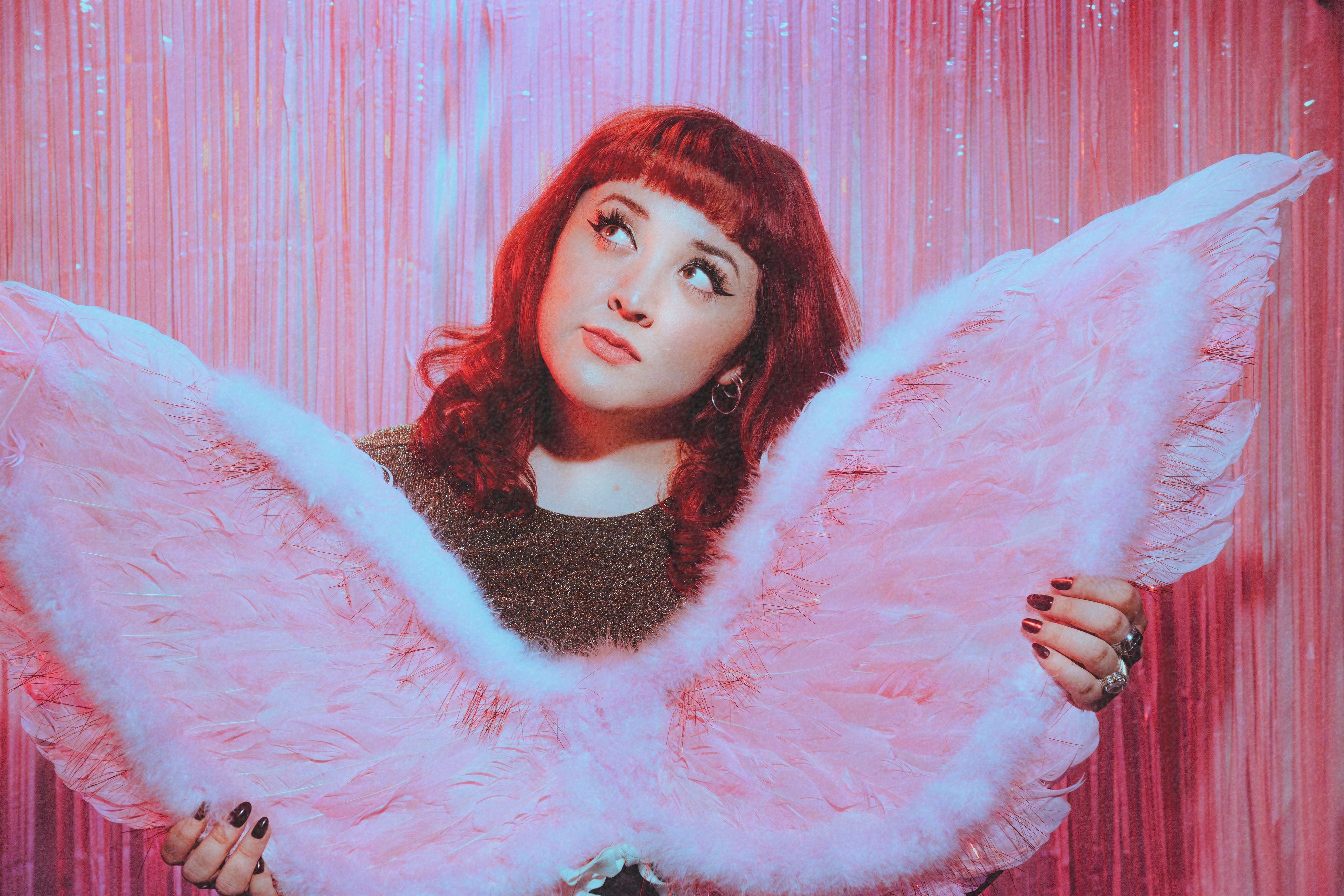
It was a little challenging, but it was also cathartic,” Shunkan remarks about writing for her upcoming album Kamikaze Girl. Marina Sakimoto’s project under the moniker of Shunkan revels in the push and pull of delicate, quiet moments and blistering, fuzzed-out bliss.
From one of the most challenging times in her life arrives an album embracing the personal struggles and the creative freedom in which she made it.
Tucked away in the desert of Joshua Tree for recording sessions and rid of all other distractions, Shunkan had no choice but to sit with her feelings to write her most vulnerable and reflective album yet.
“Hellbound,” a moody song with 90s alt-rock undertones, and “Usual Suspects,” an upbeat, emo-inspired track delving into a new direction, are the first two singles from Kamikaze Girl. They arrive with a common thread of recognizing and accepting the negative traits burrowed deep inside, but still trying to piece life together. It’s a recurring theme on the album- the self-destructive tendencies referenced by the title itself.
Now with the release of Kamikaze Girl coming up on May 6, Shunkan discusses why this album feels different, her love of film, and being more introspective than ever before.
Culture Flux: What’s the biggest difference between who you are as a musician when you started playing to now?
Shunkan: Oh, I’d say, certainly a lot more experience of course. You know, life and I think it’s intuition too- just kind of knowing in your gut what you like, what you don’t like, what you want to make. I always say, I just want to make what I hear in my head, what I want to listen to, and I just go with that, and I try not to pay too much attention to maybe what’s going on in general.
I mean, of course, I’m listening to lots of new bands, but also a lot of old bands. I just want to make what I want to listen to. That’s really just kind of my thesis statement I guess, when I’m making stuff.
And as far as Kamikaze Girl, you know, this is going to be your first album through Rite Field Records. So why did you feel like they were the right label to release this album through?
Well, Parker [Hernandez] and Joseph [Hernandez] are great. I’ve known them for years. Parker helped me with some artwork. I wanted to make tarot cards for my second album, and they beautifully illustrated each song as its own tarot card.
Ever since then- that’s probably around like 2018- we’ve just stayed in touch. Then I saw that they started this label, and we’ve always had a similar taste in music, and their focus is very musician driven as far as a label goes. I think that’s kind of their differentiating factor, so that really spoke to me.
They’re also musicians as well and creative, so they’re just very open-minded and fair when it comes to all the stuff on the back end. They just really believed in what I was doing and I think they got it, so that was really important for me.

And you recorded the album in Joshua Tree, right? So how did recording in a really remote environment like that affect the writing process of the album, then the final outcome as well?
I loved it. I have never done anything like that before. First of all, I love Joshua Tree. It was this beautiful studio kind of in the border between Yucca Valley and Joshua Tree, and everything was on the same property, so I rarely left the property! So it’s very isolated, and it was just Alex [Newport] and I working together, one on one, and of course we had Aaron [Farinelli] on drums for a few days at the beginning, but it was mainly just Alex and I.
And it was really cool, because there’s just no distractions. There’s nobody coming by, or your life, like your normal day-to-day stuff, is not really in the picture.
That was a quite a luxury, because I’m used to working with the tightest budgets you can possibly have, and being very thrifty over the years. And you know, just having like a few days to work with. This time I had two weeks, and that was just like crazy for me. So yeah, I was able to include all these little details that that I’ve always wanted to.
Do you think that you experimented maybe a little bit more, since you had that longer period of time to record?
Yeah! And also there was a lot of pre-production with Alex. Alex is very hands-on, which I really liked. Of course, he’s also a musician and artist and an amazing producer, and I just love how creative he is. A lot of it was pre-planned.
We kind of had a game plan going in, but with that, there were ways to experiment, whether it was with pedals, effects, things like that, and kind of toy with that, but sort of the groundwork was laid out. So that was actually kind of nice. The most organized recording sessions have been for me ever was working with him. So yeah, that’s how we’re able to kind of improvise, I suppose, was just sort of vibey stuff.
You did record in such a beautiful environment, but you said that the album was also written during one of your most challenging years. So how did the headspace that you were in at the time affect how you were writing and how you approached the songwriting and the sound of the album?
Oh, yeah, so weirdly enough, like with previous albums… I was kind of afraid to really talk about like stuff that was going on. Maybe more of like, filtering them through surrealist, little weird stories that I would make or something.
But like with this album, I just felt like, “OK, I really just want to write exactly, maybe what’s going on,” or maybe a specific relationship happening or tragedy that is happening around me. I was curious to try to do that and I actually found it to be the most interesting stuff that I’ve done, because it felt like the most honest and during the recording processes it’s tough because you’re revisiting material.
And you know the people that you write about… some of them I don’t talk to anymore. It was a little challenging, but it was also cathartic, because I wanted to move through that, and I wanted to move past it. But at the same time honor that time period, and honor who I was at that time, and not totally be upset with them or or judge them, but just to kind of like honor what it was. So it was pretty cool, but very interesting to work through in the desert by yourself.
Did you find that you were more reflective than usual when you’re writing? Because those lyrics do sound more introspective, not only about yourself, but about like, interpersonal relationships and relationships with friends or significant others. So did you feel yourself being more reflective than you usually are during recording and writing?
Oh, yeah, 1,000%, because a lot of the time before, what was on my mind was mostly logistics. A lot of the time I was either working with other band members and sort of being the leader in that regard and kind of helping them out and kind of, I don’t know, leading them when they were recording or just working with technical aspects. But this time a lot of the technical aspects in the production- it was all taken care of, everything was so lovely and set up.
Really, all I had to do is just sort of go in and center myself, and just kind of bring myself back to that place where I was, and I was writing, and then kind of perform it like a scene in a weird way. That’s kind of how I see it, like singing, at least. So yeah, I had a lot more space in my head to go there I guess.
Did you feel like you learned anything new about yourself from making the album?
Yeah, I was pretty close to feeling like, not giving up, but just really sort of being cool with whatever. I knew I was always going to make music for the rest of my life, but if people were going to hear it, that was up for debate, I suppose [laughs].
So with this album it just kind of feels like if you just keep trying, despite any sort of adversities or lack of means or anything, and just really keep going forward or trying, maybe things can work out, and that I still have that in me. Life hasn’t totally sort of made me nihilistic enough to like completely quit, or to stop trying or anything like that, so it was definitely a confidence boost like, “I should be doing this and I should keep trying.” And yeah, hopefully, people like it, but it’s the album I’m happiest with.
Do you feel like right when you made the album that you knew when to stop a song? Because I feel like you know, some people say, “oh, I could keep tinkering with this song for hours and hours.” Are you good at knowing that endpoint of when it’s finished, or do you in your mind still have things that you want to experiment with?
Oh, my gosh! That’s definitely one of my biggest issues is not knowing when to stop the writing process, because I can just keep layering forever into infinity. And of course, luckily Alex was there in the pre-production, where he was helping me write, and kind of guiding me through that so it wasn’t getting too intense or being too distracting from certain elements. He really kept emphasizing my vocals and stuff and not trying to detract from that.
So yeah, my instinct is to want more guitar or more melody or something. He really just kind of held it back, and refined it so it wasn’t totally lost in itself.
That kind of difficult balance of feeling free to do whatever you want, but also having to have a little restraint, I guess, too.
Exactly! That’s a skill that I’ve learned over time, and I think I’ve gotten a lot better with, is just editing yourself and refining. Yeah, I think it just comes with experience, honestly.
Can you talk about the album cover? I really love the album cover, how it has all these multiple images all in one. So there’s always a lot you can kind of take away from that. How do you feel like it represents the album?
So I found this piece of artwork… it’s a beautiful artwork. I believe it’s from a German artist, and the title’s called Mothers, I believe. It was an etching, I think, like a wood block etching. It’s just basically all of these mothers huddling around a child, and the child is kind of peeking through at the very bottom.
I really liked that concept of just feeling enveloped by different stages of my life, and sort of coming to peace with that. I just found it to be a very comforting image, but also there’s that kind of little, I guess, kamikaze girl, where it’s that little bit in myself, at least, where it feels like they want to rebel. They want to self-sabotage and despite all of this support and love that either you give to yourself, or that others in your life give to you.
Again, it’s not judging that or anything like that, but yeah, I kind of wanted that represented in the artwork but to the artist’s interpretation, not just a direct copy of the original inspiration. So their interpretation, I just let Alice do whatever she wanted. It was just a really cool, fun, beautiful, almost watercolor collage of just all these different elements. I felt like she really captured the spirit of it without it being, too… again, like nihilistic, or there’s like a lightness to it. There’s a feminine aspect to it. Yeah, that I kind of like that balance, I guess.

And I really feel that balance with the album because you play with dynamics a lot. The contrast of the soft and the loud… that kind of helps into the emotional state as well. So how far into writing a song do you usually figure out those dynamics- when to get louder, when to get softer and tone it down a bit more?
It’s tough because I’m one of those people where I’ve got a lot of anger and sadness, and it’s all in here, but I don’t necessarily express it all the time, day to day. I’m usually pretty chill, so when I’m writing and I’m making my art like I try to, you know, express it that way, but sometimes it’s a little intense.
It’s really sort of like taming it is the tricky thing. I just have always really loved that, that fine balance between softness and then that really prickly intensity- that darker, shadowy self. And I also think it’s really important for, like anyone, especially myself, being just a woman in general, I just I like to be able to express both sides. I don’t like to feel like I gotta go into one or the other, but it really is just more of for songs- when you’re really tailoring the production- it’s just like, what’s working for each part, whether it’s your vocals, like, depending on what’s going on instrumentally, too, it’s really just a fine balancing act.
Sometimes, really, just what sounds best sonically is just gonna trump the rest. And this album, I’m glad I was able to have more softer vocals and things like that. I haven’t really been able to capture that as much before. So yeah, I loved the vocal dynamics, especially with this.
Did you write the lyrics before the music, or did it just depend on which track you were working on?
Yeah, totally. It totally depends. Like most of the time a line just hits me while I’m driving stuck in traffic or something. Then I’m just recording on voice memo, what that is. Then I have a lot of voice memos where I’m just making a beat on the steering wheel [laughs]. I’m just saying notes to myself, but yeah, it really just depends on what the inspiration of the song is. Sometimes it’s just a line that I think sounds interesting.
Then I think less often it’s just, “oh, I came up with a riff that I really like” and “what is that? What’s the mood of that riff?” And then going from there.
Why did you choose “Hellbound” as the first single and the first taste of the album for listeners?
I felt like it was a little different from stuff I put out before. So I wanted to sort of introduce myself, I guess, again in a way that maybe differed from previous singles. It honestly just represents a lot of music that I currently listen to. Yeah, I kind of I don’t know why in the past I wasn’t doing that as much like…it’s like another reflection of who I actually am, and what I’m actually doing and and stuff. So I really just wanted to kind of come out with something different.
Do you feel like your musical taste has changed since your last album? Has it been really drastic, or has it been kind of a gradual interest into something different?
I think it’s been gradual, but a lot of the time it’s where I’m at in life. There was a while, I think- especially for the second album- there was a point where I just wasn’t listening to a lot of music in general, and it was kind of hard for me. I felt kind of sick of music at one point, so I really dove into film for a while.
Then eventually, honestly, the past couple years or so, I really got in touch with myself again and and issues that I was having, especially with my relationship with music and the whole business of it and everything. I just kind of fell in love with it again, so my taste expanded. But I was also revisiting a lot of old stuff that I’ve loved for years.
I remember at one point I was listening to the Lost in Translation soundtrack. I kind of felt like, “okay, maybe I gotta get in touch with this side of myself and see where that goes,” because I was definitely in a sad place…a lonely kind of place.
Were there any other albums that you were listening to during the creation, or before writing the album that inspired you creatively, and to kind of take risk and be more emotionally vulnerable with people?
Okay, a lot, I guess, for different reasons, I suppose. For production, for example…it’s so random, and I doubt that any of these elements are in the album at all, but there’s a Sneaker Pimps album…
It’s one of their very underrated albums that really nobody knows about, but what really drew me to it was the production style. I was like, so inspired… oh Splinter! Okay, yeah, so it’s from ’99. Splinter has crazy production on it, and it’s trip hop, but it’s also a little shoegazy and poppy at the same time. I was so inspired by like… all these little moments of production. [They] were like, wow… I feel like I don’t hear that as much anymore these days, and so I kind of wanted to just inject that a little bit, but then there was albums for other reasons.
I really fell in love with Failure the band, and specifically Fantastic Planet, and I’d say, Magnified, too, were just really big albums for guitar tone, for how heavy the guitar was, but also just emotionally, too. I think all of the lyrics are really written beautifully, and again feel very personal, but they’re very interesting. They all stand out, and they’re very individual, and they paint very vivid pictures. That was really striking to me, too, so it’s kind of all over the place [laughs].
Do you feel like that era of music is special to you- that kind of alt rock of the early to late nineties?
Oh, yeah. I mean, I’d say it’s like my core and I’m happy to hear that there’s an influx of it now, because there’s just such a power and intensity that I’ve been missing a lot, especially a lot of music I’ve heard contemporary-wise, where there’s like a heaviness, and there’s a grittiness to it, but it’s also very beautiful. I love that complexity and depth. There’s like such depth to it, whether it’s the production or just the lyrics. I love lyrics that could be like more literary lyrics, I suppose. That is always really interesting to me.
But I know if I had to really pick a sort of time of music, I would definitely say that would be my era of music. I think it’s also cool, because a lot of the times it’s written in like, a pop structure, too, so a lot of the times it was radio-friendly and very accessible and popular.
So I mean, it was just definitely a different time, but I just love that because good songs just translate universally. And on top of that, it just being cool sonically. Yeah, it’s just the best combo.
So I also want to ask, since you mentioned the Lost in Translation soundtrack, I wanted to mention film. You said you got into film a little bit when you weren’t listening to music as much, so how has film inspired you musically? Do you take direct inspirations from film, or is it more of like the mood or the tone of a movie that can inspire you?
Oh, yeah, 100%. Especially when I was having a hard time listening to music. Around that time I was listening to a lot of oldies, too, and just getting really lost. And of course, that kind of worked with a lot of the old films I was watching.
Yeah, it’s really just a mood thing like. I think it really started… my favorite movie of all time would be Ghost World. It has been for like, half of my life, and it kind of really started there, as far as what a mood can convey. That’s really it. It’s not so much about structure or plot, or, you know, beats, anything like that. It’s mainly just those quiet moments with a character, or like a conversation.
Reality Bites is one of those very moody, vibey movies for me, again, for half my life, those are kind of like my core films, but of course it expanded. This past year even I’ve expanded my repertoire a ton, but that’s really kind of where I started. So it’s just.. “how do you capture that- that vibe?” I would try to make it into something that you could hear, or maybe like in the back of my head, I’m thinking: “oh, it’s playing on the radio,” or something like that. So that’s always fun.
Are you gonna be doing music videos for this album and kind of having a visual representation of some of the songs?
Yeah, definitely! We’re working on it now, but that’s especially…. me falling back in love with film again, and also physical formats, too. I have the VHS collection. I love seeing film on 35 [mm], 70, 16, whatever I can get my hands on. So yeah, I’m looking at it differently now. It’s definitely important to me to have kind of like a cinematic visual moving forward just because I love film. I just want to experiment in that way, and sort of represent it that way, too.

And I guess, since you’re based in LA, you have a lot of opportunities to see really cool film screenings.
Absolutely. I’ve put on a couple screenings recently. I love being a part of like the film rep scene here. It’s awesome. A lot of the album was written when I was frequenting theaters all the time, almost like multiple times a week. And just really sort of getting lost in it, but also finding community again and being able to form friendships, relationships that way and just being so inspired by all of the films that I was seeing.
Even one of them was so powerful for me, which is a pre-Code 30s film called Queen Christina, and it’s just unbelievably cool and I recommend everyone see it. But that was like a personally inspirational film. At that time, too. So yeah, we’re very lucky here. I think a lot of people here take it for granted, but we have a lot of great opportunities to see film here.
And so what are some movies that you’ve seen lately that really connected with you? Could be new ones in theaters or could be older films that you’ve seen.
Gosh! Something that’s really connected with me….
I hesitate to mention this because I wasn’t super crazy about it, but SubUrbia by [Richard] Linklater was really interesting. It’s one of the more underrated films of his, and it’s understandable because it’s not written by him or anything. It’s written by a playwright… gosh! Again, slipping [with] his name, but he did Talk Radio [playwright Eric Bogosian].
There’s kind of a nihilistic aspect to it, but it was a very personal tale about him growing up in suburbia in Texas, or I suppose for him it wasn’t Texas. I think it was on the East coast, but it’s shot in Texas and it’s interesting because it features a musician who gets big and leaves town, and then comes back to the small town and sees that his high school buddies are still hanging out outside the convenience store.
There’s a lot of darkness there where it’s just like, hopelessness. I could relate to that just growing up in suburbia knowing kids who died young and you know, substances and my own personal experiences with substances. And so it’s just like a very provocative film for me, maybe not one of my favorites, but it was really provocative, and made me think a lot about my own life. So that was really interesting.
But a lot of the time, I’m also just watching B films like, B horror movies. That’s really like my happy spot. So I rewatched The Being lately, or recently. It’s a really absurd film about an alien creature [laughs], or like, I don’t even know what to call it, like a chemically nuclear alien creature, but yeah, I don’t want to divulge [laughs]. You probably don’t have the time. But yeah, yeah, I I love it so.
I feel like we as humans don’t always give ourselves a pat on the back for a lot of the things that we do. So I want to ask, what are some of the things that you’re most proud of accomplishing in the last few years?
I would say, just writing this album and refining it- finding people that I feel so honored to work with. That was a huge accomplishment for me, and also just making it this far. I’ve been struggling with mental health since I can remember, and I never want to pretend that it’s not a thing. I’m always happy to talk about it, because, you know, it’s just amazing to me that I’m just even still able to do what I love. I’m just grateful for that.
So yeah, I feel like I’ve gone through a lot of tough times, and just personally, too. I’m stoked for that, and just recording this album. I was really intimidated by it. I’ve never done anything like it, so I was very proud when it was done.
I am just an anxious person in general. I’m an overthinker. I’m a bit of a perfectionist with things. I’m trying to unlearn that, so just doing something like that and not having a total meltdown… beautiful. I’ll take it [laughs].
So, since the album doesn’t come out till May, you said you’re an anxious person, so is there more anxiety leading up to the album release? Or is it more excitement for it?
Excited! I’m actually really proud of this album. There were times in the past where I felt a little…frustrated in the sense of like, “oh, I couldn’t do everything that I wanted to, or I wish I had help here” or whatever, and so I was very insecure because I didn’t feel like it was fully what I wanted to put out there.
This go-around, I’m excited for it to be out there. I feel like it’s an accurate representation of what I want to be out there, so I’m excited.
Is there a particular song that you’re most excited for people to hear, or that you feel challenged you in a particular way?
Yes, the track “Prettier.” I had a tough time, for some reason, finding a chorus for that, and I also feel like it’s probably my most emotionally raw, possibly of the record. Hard to say. I felt like it was certainly my most vulnerable and when I showed it to the label, Parker said they cried, and I just felt kind of bad, but I mean, they just felt like they really resonated with it.
So I’m interested to see to see what people think, because it’s a little different than what I’ve put out before, and it’s a little longer, but it’s very dynamic, and I think it showcases the range of the album in a good way.
Yeah, it’s a really beautiful track on the album. So I wanted to thank you for your time today. And as my closing question, I wanted to ask what are some goals or things that you want to accomplish in the next few years? Could be music, could be outside of that.
Yeah, I would love to get back and just to playing again. I think that’s my next big hurdle is feeling comfortable on stage again and touring, and I loved touring last time we did it, so very excited for that. But my big kind of bucket list goal [is] to be placed in a film. That’s just something I am trying to manifest for myself- working with my licensor with that. So that is my big goal for the next few years. If I can get close to that, that would be awesome.


Leave a Reply