
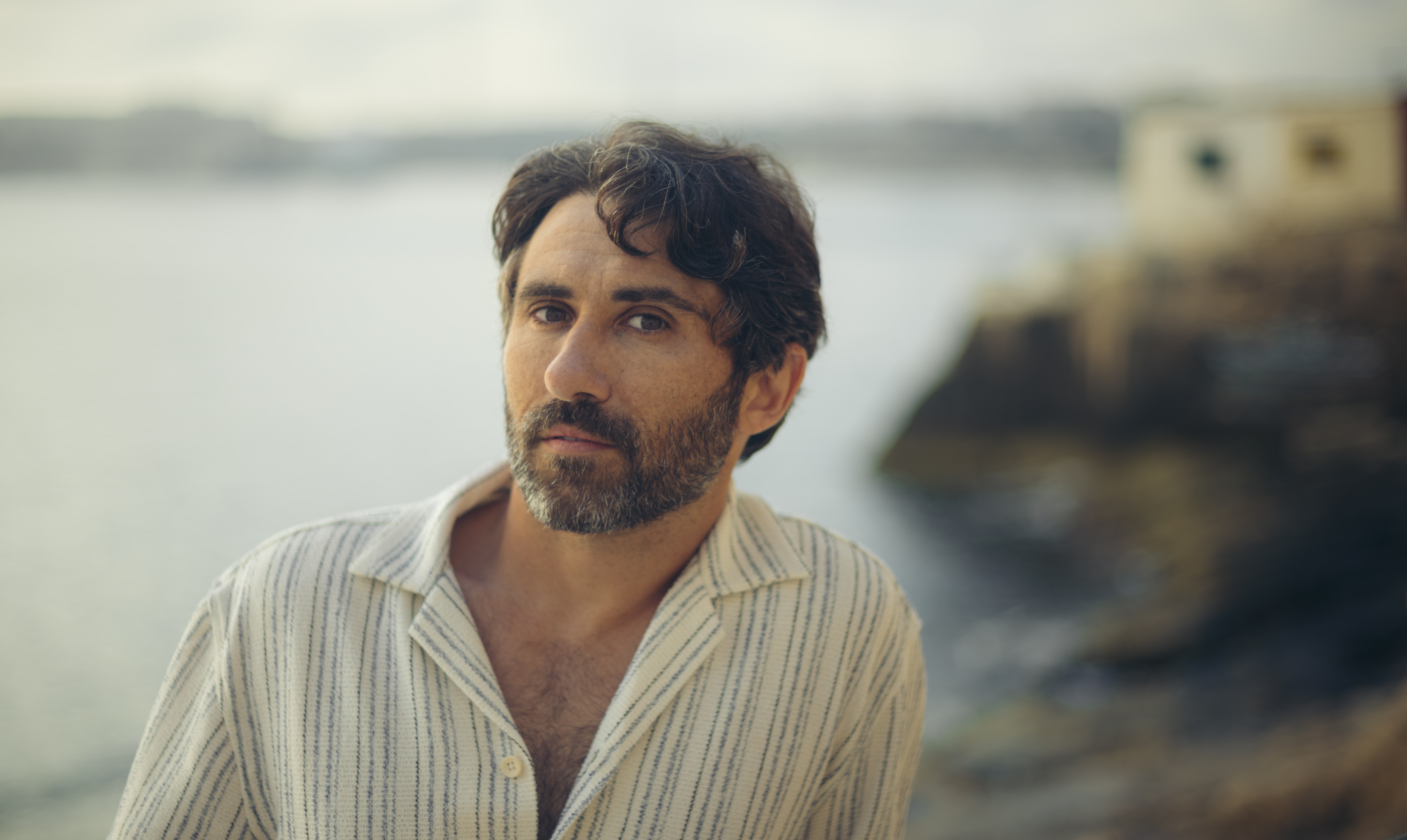
Even Mobley himself admits that his music is hard to categorize. The singer, songwriter, multi-instrumentalist, producer, and filmmaker (and probably many other descriptors) doesn’t let genre get in the way of a good song on his full-length debut We Do Not Fear Ruins.
The album arrives after years of songwriting and touring, but it was still the most challenging body of work for the seasoned musician. Mobley was continuing a story left off from his exuberant 2022 EP Cry Havoc!– a sci-fi tale of a working class man caught up in political upheaval during an alternate 1980s.
Somehow We Do Not Fear Ruins manages to be retro and modern all at once- nodding to Ennio Morricone’s spaghetti Western scores during the opening track “The End,” and then weaving through groove-driven rhythms harkening to the 70s and modern, layered production while telling a story with relevancy to the political and social climate of modern-day America.
Mobley’s creative direction didn’t end with the storytelling: he’s also the music video director/writer and conducting the production set-up for his truly unique one-man band live performances (as he explains, preparing a new song into the set can take a whopping 70-100 hours).
Now that the album has been released to the world, Mobley chats about the challenges of making We Do Not Fear Ruins, science fiction as commentary on society, and conceptualizing such an overall large creative output.

Culture Flux: First I want to ask if growing up, if you always had a good ear for music, and was being something like a musician or being involved in music something you wanted to do since you were young?
Mobley: I’ll answer the second one first I guess. In hindsight, I think it is something that I always wanted to do, but I don’t think I had any sort of concrete sense that it was actually a job that people did until I was older. You know, I knew musicians existed, obviously, but if you don’t have access to people who are involved directly in it, It’s all very honestly, even now, like years and years after having been in the music industry, it’s still all pretty mysterious and on top of that, you know, there’s the kind of mystical aspect of the art itself.
So I think I did want to be a musician, but I don’t think I knew that it was possible for me to be a musician, and then I just as I got older, it became clear that I’m just wired in such a way that it was going to be what I was going to be spending most of my time on, whether I could make a living at it or not, and so I decided to put energies toward figuring out a way to make a living at it.
In terms of having a good ear, obviously that’s a subjective thing, but I think I again, it’s a thing I realized when I was older. For as long as I can remember I’ve always just heard music all of the time and sometimes that’ll be songs that I have heard. And then, as I got older, I realized some of the stuff I was hearing in my head was stuff that I had never heard before. I always just called it my radio. I would just hear music all the time, and probably, I grew up in church, and probably when I was like 9 or 10. I started hearing harmonies that nobody was singing and then trying to sing those.
So I guess yeah, I’ve had an ear for it for a long time, but again, I wouldn’t have thought of it as anything exceptional. I still don’t know whether it’s anything exceptional. But yeah, I wouldn’t have had a name for it until I was much older.
Culture Flux: So you just kind of had these sounds in your head, but that was before you learned about chords and progressions and arrangements and things like that?
Mobley: Yeah, most of my knowledge about that stuff is still pretty intuitive. I’ve been kind of assiduous about avoiding becoming too knowledgeable about like, Western theory traditions and just kind of keeping it an intuitive thing as opposed to an intellectual thing. I have a tendency to over intellectualize things, and I didn’t want that to happen to music.
Culture Flux: I can see how that would be difficult too, overanalyzing things, because your music is so layered and textured. I imagine it is difficult sometimes, right- to know which avenue to take and how far to delve into a song until you feel like it’s finished?
Mobley: That’s absolutely true. If you have any tips on that, you’re more than welcome to share them [laughs] because I yeah to this day still don’t really know when a song’s done beyond you know, it’s time for me to turn it in.
Culture Flux: Do you have a framework for how you want a song to sound when you start it or are you just kind of starting from scratch?
Mobley: Something people have said about my music for as long as I’ve been… certainly, as long as I’ve been in professional music, is that I’m very hard to place from a genre standpoint. I kind of hop around a lot.
I would say recently, more recently, you never want to be thinking about how you’re going to sell the song while you’re writing the song. That’s a terrible place to be. I’ve never had anything good come from being in that frame of mind while I’m writing. But I think I have tried to, since I know the genre isn’t going to be a calling card for me. It’s not just gonna be like every single song I make is exploring this particular territory from a genre standpoint.
I have tried to pay attention to my own process and figure out what my calling cards are, whether that’s production stuff or lyrical approaches, or you know my voice, which is obviously the the most kind of intimate and personally identifying part of my music.
But in terms of a framework, no, I mean, I wish I did. I really wish I could say, “yeah, these are the things that I do.” But no, it’s very different. Sometimes it starts with a lyric. Sometimes it starts with an idea on drums that I have. Sometimes it’s guitar or piano. Basically any way you can start a song, I’ve started a song. I guess the part of my process that is a little weird compared to at least the people I’ve talked to is I am creating the song from start to finish by myself.
I tend to make the production process part of the writing process. So very frequently, for example, I will have picked exactly what kind of compression and distortion and reverb is going to be on my voice before I finish the lyrics. And so I think that can have kind of a- I don’t know how discernible that is to you know your average listener- but I do think that I can have kind of a feedback effect. There’s a dynamism to the interplay of that where usually it would be.
I have the chords and the melody and the lyrics, and none of the production decisions have been made at all. So yeah, that would be my thing, that everything kind of all happens at once. It’s kind of a mess.
Culture Flux: Yeah, I mean, it works! Have you ever been in a band or have you always created music on your own?
Mobley: I did used to have a band. Mobley used to be a band. It was a quartet for a while, and then a trio for a while and then a duo for a while, and then it was just me, but I was always the one writing and producing and overseeing the arrangement and all that, and I wrote most of the parts for the other players, even when I had a band.
So things haven’t really changed that much in that regard, but I do a fair amount of production and songwriting work for other artists. So I have had the flip side of that experience of being somebody in the room just offering ideas, but not really having any decision-making power. And it’s pretty great [laughs]. I like not like not being saddled with the responsibility of deciding what the thing is going to be, but rather just, you know, helping somebody realize their vision and being a sounding board for them.
Experientially, it’s really great. It’s not fulfilling in the same way. The experience of making my own music is a lot more, let’s say, taxing, to put it mildly, but the gratification at the end of it is much bigger.
Culture Flux: You said that working on this new album has been the most fulfilling challenge for you artistically. So how did make this making this album feel different for you, and in what ways was it more challenging than before?
Mobley: I think artists have a tendency because of norms and criticism, and the ways in which and dominant culture in the United States, because of conventions and the ways that we talk about art and authorship, and the way that we think about artists… artists feel a pressure to play up the role of intention, and in the art-making process. Obviously, intentionality is very important, but everybody I know everybody ever made art with everybody ever talked about this with, and certainly my own experience bears this out, would would tell you if they were being completely honest and not trying to sell themselves.
It’s at least half just accidents and weird stuff that happens. And then you chase it down and half, I think is a low ball estimate, and that reality had kind of governed the way that I made art up until this album, where there would kind of be a… I don’t want to say a hodgepodge exactly, but there would be… I would be making art, and I wouldn’t really understand the way it all connected to each other. And then at some point in the process, I would see the thread. And “oh, okay, I get it. I get it. This is how these all fit together.”
And this is the story that I tell when I talk to people about this art. And I don’t think there’s anything wrong with that. I actually think that’s good. I think having that kind of like detached humility when it comes to what you’re making, can be really generative. But with this project coming into it, it’s a concept album. So I had a very clear story. I had very clear themes that I wanted to talk about. I had, you know, parts of the narrative that I wanted to allude to or illuminate in the lyrics and reinforce with, you know, some of my sonic choices.
So I was coming in with a bunch of intention, but way way way more than I’ve ever had coming into a project, and as a result I had loads and loads of ideas that I loved, and when I came up with them, and still love and hopefully will eventually get a chance to make use of, but there was this, you know, editor sitting on my shoulder, who’s keeping track of, you know, “well, does this advance the story? Does this reinforce the theme? Does this make sense within the world you’re trying to craft?”
And so, as a result, you know, I’d love to say, “oh, I had these intentions. And then, as a result, I just went and found exactly what I needed.” But really, the way it actually felt was, I made art the way I always make it, but I had to throw a bunch of stuff away because it didn’t quite fit with what I was trying to do, kind of regardless of its merits on its own terms.
I think that was the really difficult thing like, finding and holding on to the discipline to not kind of contort the thing I was making to conveniently fit these pieces of art that I was coming up with that I really liked, but instead keep pushing myself over and over and over again to throw out these things that I loved at least temporarily, and then keep searching for the actual thing that kind of fit the brief that I’d come up with beforehand.
That was very difficult, and then, yeah, really gratifying in the end, because I’d never pushed myself to do that before. I think it resulted in a kind of integrity and cohesion that if not better than things that I made previously, certainly different, very different from things that I made previously.
Culture Flux: Was it thematically what you were looking for- to find a through line throughout the album, or was it more of the musicality of it that you were challenged with?
Mobley: It was everything honestly. Thematically, with regard to the lyrics, I was definitely trying to hammer home this core set of ideas, and relatively speaking, that was easier. I have a much easier time with words than I do with music. I can kind of go ad hoc, or post hoc, with words with fair facility, but with music, if lightning doesn’t strike, it’s more a case of me like kind of being down in the song mines, like kind of trying to find the gem. I can’t just make it happen. It’s just a matter of applied persistence.
In terms of the struggle, I would say it was definitely a musical thing, where, for example, the opening track of the album starts with this kind of noise-based sound design, and then transitions into a voice over and then that transitions into this piece that alludes to [Ennio] Morricone’s spaghetti Western scores, and I had very particular ideas about how fast, roughly, I wanted that to go about- the kind of feeling that I wanted it to evoke.
I haven’t educated myself too much on formal Western music theory, but I knew that I wanted it to be in the Dorian mode, because I knew that there were references that I’d heard from like the 70s that were in the Dorian mode that had this kind of open but mysterious quality that I thought was really appropriate for starting off this like sci-fi concept album.
So it was a pretty detailed list of things that I wanted to hit, but then I also didn’t want to do it as this box-checking exercise. I wanted it to feel inspired, so like waiting day after day for something that fit the description, but was also inspired to come along was just, you know, both in terms of the outlay of time, and in terms of just what it does to you from an emotional and morale standpoint, it was difficult.

Culture Flux: And you’ve also with this album, continued the story of the Jacob Creedmoor character. So what is it about that story that you felt needed to go on, and shouldn’t be finished with Cry Havoc?
Mobley: I always when I was making Cry Havoc, I always knew that was kind of a prequel to the work that I was going to do on the ultimate album We Do Not Fear Ruins. I grossly underestimated how long it would take me to get from the way that record ends to completing the album. It ended up being longer and covering a lot more ground than I initially thought that it would. But the story itself actually was the Jacob Creedmoor story and Cry Havoc as a title were actually the title and the basis for an album that I recorded and then never released. I just scrapped it, probably seven years ago, or something like that now, because it didn’t feel right at the time.
Then by the time I came back around to the story, I still felt very compelled by it, and interested in it, but knew that the music that I had written before for the most part, wouldn’t work sonically with what I was trying to do now.
I guess, for people reading this, I’ll lay out the basic sketch of the story. Jacob Creedmoor this character is a dock worker and aspiring musician in this alternate universe- early 1980s New York- and he gets involved with some radical dissidents and engages in direct action that results in him getting arrested and taking to a site where he’s held in suspended animation and that’s kind of where Cry Havoc leaves off, but I always knew that just sounds like the start of a story. That doesn’t sound like the whole story.
There’s a lot more story to tell even post this first album. I don’t know if you’ve ever done any fiction writing, or kind of like world-building in your head, but you don’t even have to commit very much time to it before it kind of draws you in and engrosses you with possibility in terms of, you know, imagining the details of multiple lives, of societies of all these vast things, and then the kind of utility of those ideas as a tool to speak to things happening here in the real world. It’s just very irresistible to me as a writer.
Culture Flux: That’s what’s interesting about your lyrics, because even though you have a sci-fi leaning to the lyrics, there’s still this relatability to people and a drawing on current events as well. So can you talk about mixing science fiction and personal themes, and why you felt that was the right avenue to mix those?
Mobley: Yeah, I mean, there’s a very long history obviously in terms of sci-fi as a tool for social critique. You know, like, for instance, alien invasions as a trope are very tied up in either commentary on or anxiety about colonization and anxieties and fears about what would happen to colonizing people where the roles were reversed. And that’s just one of many, many examples. So that attracts me, because I’m constantly thinking about social issues, political issues, systemic issues.
But then the flip side of it in terms of the personal, obviously as many people much smarter than me have argued, convincingly in my view, the personal is political, but also the personal is the kind of unitary piece of which the political is comprised. In our popular discourse, we like to silo those things off as though there isn’t a direct connection. But behind every statistic that gets thrown out about social outcomes or about the impact of some policy, every single one of those units is someone’s personal life that they’re not interacting with as some matter of policy, as some macroeconomic phenomenon. They’re interacting with, as you know, life and death and love and fear and anger and shame, and a million other different things that then, you know, collectively kind of epiphenomenally result in these broader things that we talk about kind of from the 30,000-foot level.
But specifically, as someone who aspires to see the world move to a very different place from the one it’s currently in, I find it very, very important to- while giving proper time and space to talking about sociological phenomena- talking about systemic problems, structural problems… to also keep a focus on the things that we’re living for in the first place, the reasons why we want the world to be better in the first place, and for me those always come back to love. Those always come back to community and intimate connection. For me, there’s just a very natural connection between those two things, because I don’t think it’s possible to fully understand one without the other.
Culture Flux: Were there any current events that directly affected the storytelling with this album that maybe you didn’t plan on including before, when you were writing the CryHavoc storyline?
Mobley: Yeah, I mean, when I very first kind of conceived of the sketches of the story, there weren’t really any science fiction elements there. The social critique was kind of implicit. You have this working class person who’s kind of screwed over, and you have him and his family coming to terms with and trying to deal with it.
That was kind of the original version of the story, but during the process of conceiving of those things, the political landscape in this country shifted a lot. Trump was elected the first time. Everything that happened over the course of that term, Brexit, and the ascendancy of far-right parties in places like Poland, and Hungary, even places like Italy and Spain, where there’s a really bloody and not-so-distant history of fascism.
It felt impossible to talk about what it would mean, for a black working class man in early 80s New York to go through the things that he was going through without talking about the kind of antecedents of our own political moment, and then that led to some thought experiments like, “what would it look like?”
I don’t know if you’re familiar with Jesse Helms, but he was a far-right politician from North Carolina who kind of would have been right at home in some of the more extreme quarters of the present day right wing. And so I was thinking, “well, what would it have looked like if, instead of Ronald Reagan getting elected, it had been Jesse Helms?” and so on.
The cover of Cry Havoc, the Jacob character is holding up a newspaper and I actually printed out the newspaper and wrote articles and all that stuff. But the photo in the center is a is a photo of Ronald Reagan, where his face has been replaced by the face of Jesse Helms. And then that leads to thinking about the acceleration of climate change and what that would do to global tensions in a world during which the Cold War is ongoing. It led to a million different thoughts and kind of proliferating details and bits of lore.
But yeah, to answer the question directly, I can’t think of any one particular thing. It was more like the kind of zeitgeist of the moment that I was and am living in- the political zeitgeist of that moment and what that has meant for me kind of as a moral and a political actor in this society at this particular moment. In time it felt impossible to make this kind of art without making a point of casting some kind of light onto all that stuff.
Culture Flux: Are there any sci-fi films that have inspired you thematically or in terms of tone, because they have such a history of politics? I mean one of my favorite shows of all time is The Twilight Zone because if just watching it for entertainment, you can enjoy it, but there is such a deeper message. So what are so either sci-fi films or shows that have inspired you in that way?
Mobley: Yeah, I mean, I love The Twilight Zone for that reason. And it was controversial at the time of its making for exactly the reasons that you’re saying. Yeah, I would say, Twilight Zone, 2001. I don’t think I would have known it before, but I recently watched… I’m gonna get the name wrong, but the George Lucas, the pre-Star Wars, George Lucas film. It’s like, THX something. It’s a number, it’s like the ID number.
Culture Flux: 1138 maybe?
Mobley: Yeah, I think that’s right. I think that had an influence. It’s not a film, but the novels of Octavia Butler were extremely influential.
In terms of my thinking about this stuff, Moon, which is one of my favorite films… it’s David Bowie’s kid who directed it. It’s got Sam Rockwell. Yeah, I mean, I could go on for a very long time.
I would say, kind of tonally- or even Planet of the Apes– I would say tonally, like, I’m really into the kind of like… there’s this particular tone that films in, like, especially sci-fi films in the 60s and 70s had where they were dealing with these very serious issues. And the movies, TV shows were also often very serious. But somehow they just didn’t cross the line into self seriousness. It’s a subtle distinction but I think not crossing into self seriousness allows them to have this kind of theatricality that I think serves the themes really well and that I think it seems like a lot of films, sci-fi films that are being made right now, kind of have a difficulty tapping into because of the kind of popular imperative toward like groundedness and realism where sometimes, like, you need something to be a little camp, or you need something to be arched, or you need something to be just theatrical, melodramatic, whatever, in order to especially with satire- in order to kind of hammer home the thematic ideas you’re trying to get across.

Culture Flux: Is it difficult to figure out how to translate the album, and also the imagery of it into the live space both performance wise and sonically, because obviously, when you’re on stage, you’re doing so much yourself. Yet there’s so many textures to it and the imagery as well. So what is it like trying to translate that?
Mobley: Yeah, it’s tricky. So again to kind of illuminate, for any readers who haven’t seen my show, I perform as a one-man band. I’m singing and playing keys and guitar and bass and drums and drum machines and some instruments that I have built as well. And then there’s a video component, and there’s a light show. It’s a very involved production, especially for one person.
Just from a sheer, not even talking about the creative challenge of it, but just from a sheer time commitment standpoint, it takes roughly 75-100 hours to add a song to the set when factoring in all of- that’s not including rehearsal- but just like figuring out what the video is going to be, creating that designing and programming lights, preparing all the audio, programming the changes that happen to my voice or to my guitar tone, and figuring out the looping and all that sort of stuff. It’s an extremely involved process, but creatively it is a challenge… it is something that at this point [I’m] beginning at least to conceptualize as I’m finishing the song, I try not to write the song while thinking about how I’m going to perform it live because I find that to be kind of a limiting trap.
Once I have a kind of clear idea of what I want from for a song, then I kind of allow myself to start figuring out like, “okay, how am I gonna do this live?” Because I’m definitely not, as you say, my compositions are layered and texture and full of textures, and I’m not composing things that you would conventionally think of as solo performance pieces.
It mostly comes down to just leaning on experience and intuitions built from playing just hundreds upon hundreds of shows and having a pretty good sense of how an audience will react to things that I might do on stage, but sometimes that fails me. I mean, my most recent single “Had to be There,” which came out, I think it was two weeks ago today, maybe. I’ve played it live four times and the first three times- I feel very confident about that song. I feel pretty sure I wrote a good song when I wrote that song. So when I get up and play it, it’s not me standing there playing… the first three times I played it as I was playing, and I was like, “this isn’t doing what I thought it would do and I don’t quite understand why it’s not doing what I thought it would do.”
I kind of contemplated making some radical changes, contemplated like, switching up instrumentation, changing the arrangement to be a little bit different live, and then ultimately kind of decided, “well, you’re thinking about the song in this way while you play, maybe if you just think about it in this different way while you’re playing, see what impact that has.” And it’s only been one time, so I still have to replicate it, and I don’t have enough.
I have a small sample to go on here, but it completely changed. This is in Fort Worth, in fact- completely changed the way that the audience responded. It worked the way that I thought it would, and that was just a change of, literally just the thing happening in my brain while I’m playing, not even changing any parts or anything like that.
So yeah, it’s just when there’s only one person on stage. It’s just extremely, kind of counterintuitively, it gets extremely dynamic in terms of the ways in which any one part of what you’re doing can impact everything else you’re doing, since it’s all kind of located in one body. Yeah, it’s a challenge. Every single time I get up there it’s a challenge, and every single time I get up there I’m a little shocked that it works.
Culture Flux: So I wanted to ask, just to close, I know that you’re working on a novel still, right? So how far in the process is that, and what is it like continuing this story but in a totally different form of writing?
Mobley: I’m very far along in the process. It’s too long, that’s where I am. It’s too long, and I’m trying to make shorter. In terms of what it’s like, I mean, I guess it’s more, it’s more comfortable. You know, I think trying to convey an extended and complex narrative is just better suited to a novel than an album. It’s just, it’s more fit to purpose and especially after spending years and years and years, you know, constantly running up against the kind of brutal efficiency that’s required in lyric writing, especially if you’re trying to talk about complex ideas, and lyrics.
Just for instance, trying to talk about, you know, gentrification or colonialism in a three and a half minute song that rhymes. It’s just a very, very limiting space within which to work. It’s exhilarating for that reason. I very much enjoy it, but trying to do that, and trying not to stumble and you know, trip over my tongue while talking about something that’s really important is just constantly a struggle and nerve-racking, whereas you know, the relative expanse that is, the ones afforded when writing prose, it’s just so comfortable… It feels like I was on a long plane ride, you know, at the back of the plane, completely crunched up. And now, you know, I’ve in writing the novel. I’m kind of deplaned, and I’m like walking this verdant valley.
The really nice thing about it is, I always knew that I didn’t want the album to kind of be freighted with having to tell the story. So my plan was always for the album to be diegetic to the world of the novel. And so, as I was writing the novel, kind of the one the thing I could lean on in kind of making the making decisions about lyrics in particular was, I don’t have to say everything in this song or in this group of songs, because I have, I don’t know, 90,000 words, or whatever to use to kind of convey the finer points of this story.
So yeah, it’s been really exhilarating. And also, you know, just like anybody who’s ever thought about writing a novel or thought they might want to write a novel, just like anybody who’s ever thought about writing an album or wanting to do it, there’s just exhilarating to do it like, even if nothing else, even if I never showed it to anybody else, just to have done it and to know that at the end of my life I will have done that is very gratifying and very, I don’t know, It feels like something like important, but like lowercase. Important as in important to me personally.
Culture Flux: And just as my last question, within the last several years, what do you think has been the biggest accomplishment that you’ve had?
Mobley: I had a daughter. That was by far the biggest accomplishment. I have two children now, and I appreciate them for countless reasons, but from a kind of artistic and professional standpoint, the biggest gift that they’ve given me so far is for my entire life, up until they came along, I thought the most important thing I would ever do would be to write a song. I didn’t know what song it would be, but I always worked on every song I was writing as though it might be the most important thing I ever did, and pressure’s off now, because it won’t be.
Culture Flux: It feels like you’re no longer the most important thing in your life anymore.
Mobley: Not by a long shot.


Leave a Reply